Learn
Three five-year lives: write three paths
November 16, 2026
Last updated: November 16, 2026
Three five-year lives is a printable worksheet: the path you are on, the path if it vanished, and the path if money and opinion did not matter.
Download the three five-year lives worksheet (PNG)
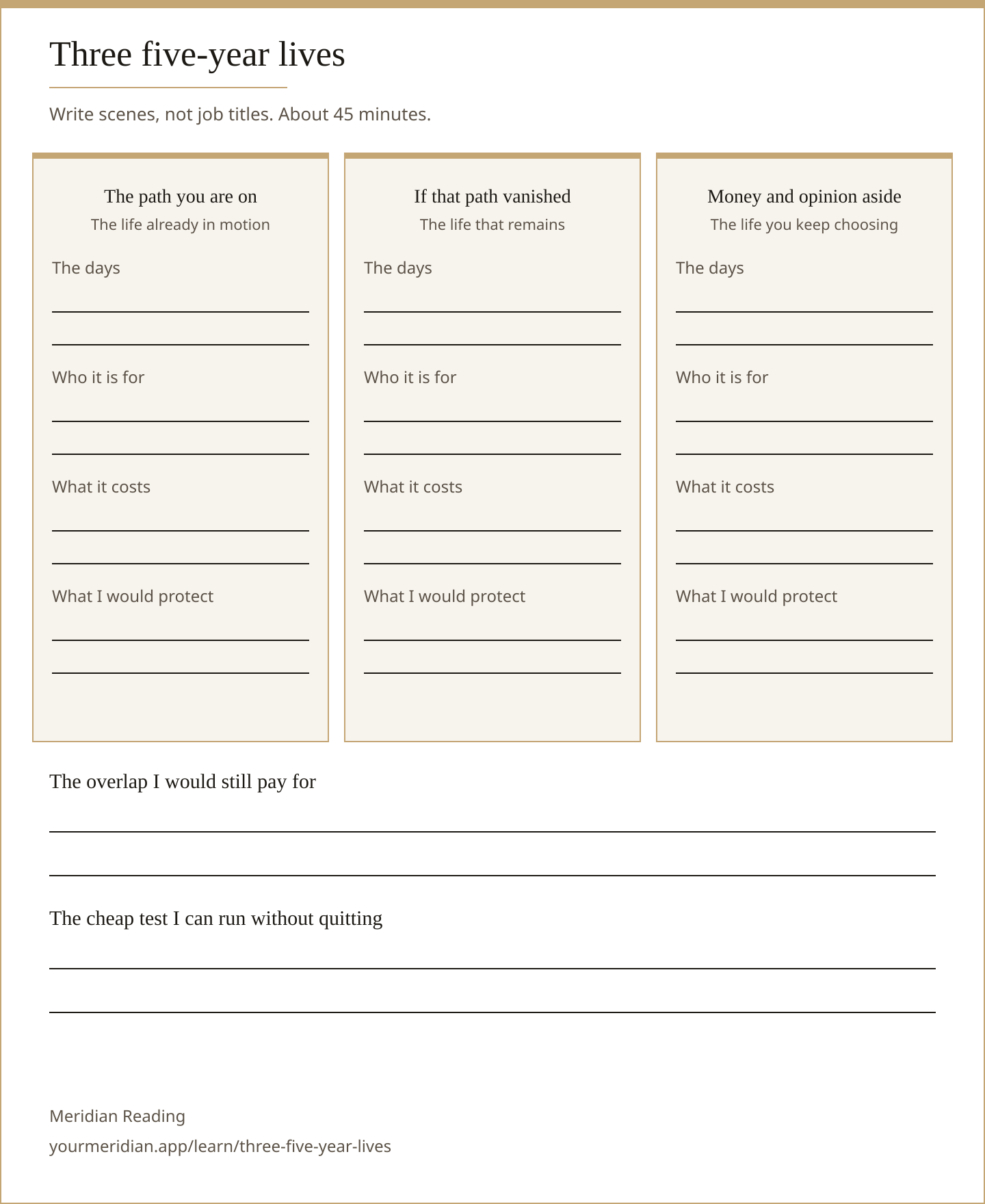
Three five-year lives is a way to see a want before you turn it into a resignation. You write the same five years three times. The path you are on. The path if that one vanished. The path if money and opinion did not get a vote. Then you look for the overlap you would still pay for.
Set aside about 45 minutes. Use scenes from a real week, not the title you hope to wear. One life at a time. If you try to live all three by Friday, you have skipped the page.
University career offices teach a cousin of this, often under the name Odyssey plan: three prototypes of a life, including the one where the current plan disappears and the one where status is not the point. Borrow the shape. Leave their forms on their sites. This page is the sheet you can print.
The longer version of want, cost, and a trial is how to find what you want to do in life. If you are choosing a major rather than a life, use what you should study while you are still undecided.
An example, filled in
Noah is twenty-seven. He coordinates campaigns for a regional retailer. He is good at the work and bored by the meeting that eats it.
The path he is on. In five years he is a manager in the same company, in the same city, with the same partner. Tuesday is a status meeting, a deck, and one campaign he still likes. The cost is that the craft shrinks as the title grows. By year two he would know whether he wants other people's calendars. What he would protect is the hour where he explains a messy system to a specific person.
The path if that one vanished. The team is closed. He uses the same skill at a smaller studio that makes materials for schools. Tuesday is production, not status. The cost is a pay cut for a year, and he has to show work instead of a title. What he would protect is the same hour: explaining how a system works, now to a teacher instead of a buyer.
The path if money and opinion did not matter. He teaches one night class and spends days on a small publication about how stores actually run. The cost he was pretending not to see is health coverage, and his parents' picture of a manager. What he would protect is, again, the explanation.
What he notices. The overlap is not "marketing" and it is not "founder." It is explaining a real system to a specific person. The cheap test, with the job still in place, is one guest class this month or one finished essay a stranger can read. He does not quit to find out.
Your page will be less tidy. That is the point. Noah's third life still had a bill. A life with no cost is a mood.
The path you are on
Write the life already in motion. Include the dull Tuesday. A five-year plan made of highlights is a brochure.
The days this life actually contains.
Who it is for, by name or by role.
What it costs: money, hours, a person, a place, a body.
What I would protect if the title went away.
If you cannot describe a Tuesday, you are writing a costume. Go get one conversation with someone who lives the unglamorous version, then come back.
The path if that one vanished
Assume the current path is closed. Not punished. Closed. The company, the program, the ladder, the city plan: gone. What life is still available from the skills and people you already have?
This column is where people either panic or tell the truth. Panic invents a total reinvention. The truth is usually adjacent. Same difficulty, different room.
The days, once the current path is closed.
Who this life is for.
The cost I would actually meet.
What I would protect here.
If this life requires you to become a person you dislike, it is not a plan. It is a threat you are making against yourself.
The path if money and opinion did not matter
Money and opinion do matter. Write the life anyway, and then write the cost you skipped. A third column with no bill is a daydream, and daydreams do not teach you what to do on Monday.
"Opinion" means the specific audience: a parent, a partner, a boss, a cohort that claps for one kind of success. Name them. A vague "what people think" is too large to be useful.
The days, if the paycheck and the audience were already handled.
Who it is for when nobody is impressed.
The cost I was pretending not to see.
What I would protect even here.
The overlap, and one cheap test
Read across the three lives. Circle what shows up more than once. A task. A person. A standard. A place. Ignore the titles. Titles are costumes the columns put on.
If nothing overlaps, you wrote three moods. Repeat one column with a real Tuesday before you choose.
If the overlap is clear, give it a test that fits inside the life you already have. One conversation. One finished piece. Four hours on a calendar you actually keep. Quitting is not the test. The fork between quit, move, and a change of work, once you know which one is loud, is which path to choose when the next step splits.
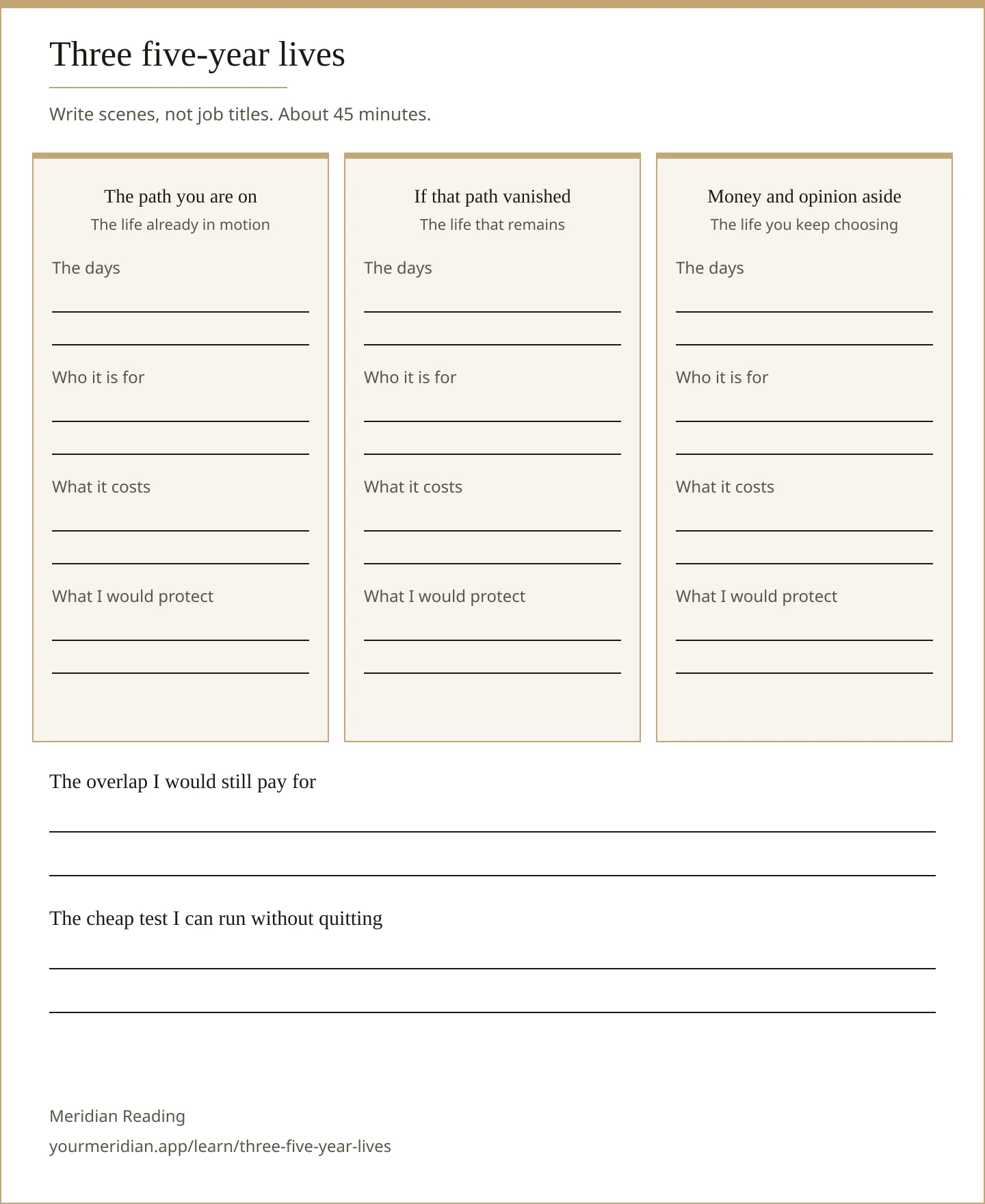
The overlap I would still pay for.
The cheap test, who sees it, and the date.
The result that means stop, and the result that means continue.
The pattern under the three lives, the part that stays when the role changes, is who you are when a pattern repeats. If the overlap is a commitment rather than a job, read how to find meaning in life again, this season.
A decision line you can say out loud: "For the next season I am testing ______ while I keep ______ fixed. I treat this as the wrong bet if ______ is still true on ______."
My decision line.
Free to copy, print, and share this worksheet if you credit Meridian Reading and link to this page.
A Meridian Reading is a private written document about pattern and season. It will not pick which of the three lives is yours. The sample reading shows the shape of that document. The lists still come first.
See it on the page
Start with the full sample reading. When you want Entry details, open pricing. Begin when you are ready.
FAQ
Common questions
What is the three five-year lives exercise?
How is this different from picking a career?
What if all three lives look the same?
Do I have to quit to use this worksheet?
Continue reading
Related guides
How to find what you want to do in life
How to find what you want to do in life: separate desire, cost, and a trial you can run now, then cross-check the guides for purpose, study, and work.
What should I do with my life? A plain answer
How to find what you want to do in life, beyond a purpose in life quiz. Use the week you have, then test one commitment you can actually keep.
How to decide between two jobs or career paths
How to decide between two jobs by separating the seat, the field, and the life around them, then testing one path while the rest of life stays put.
How to find out who you really are
How to find out who you really are: the pattern that stays when the role changes, seen in scenes rather than labels, and kept only if you would choose it.