Learn
What should I study if you are still undecided
October 19, 2026
What should I study when you are undecided: sample the ordinary Tuesday of a field, respect money and time, and treat the major as a bet you can revise.
What should I study is the question on the form, and it is a bad container for a whole life. A major, a course, or a first credential buys skills, time with a subject, and sometimes a license. It does not discover a self. People who treat it as self-discovery either freeze, because no option feels like destiny, or they grab the option that ends the conversation at dinner.
You can be undecided and still choose. Undecided means you do not yet have evidence. The move is to get a little evidence, not to wait for a feeling that names a department.
What should I study when the form asks for a major
Start with the Tuesday, not the prestige.
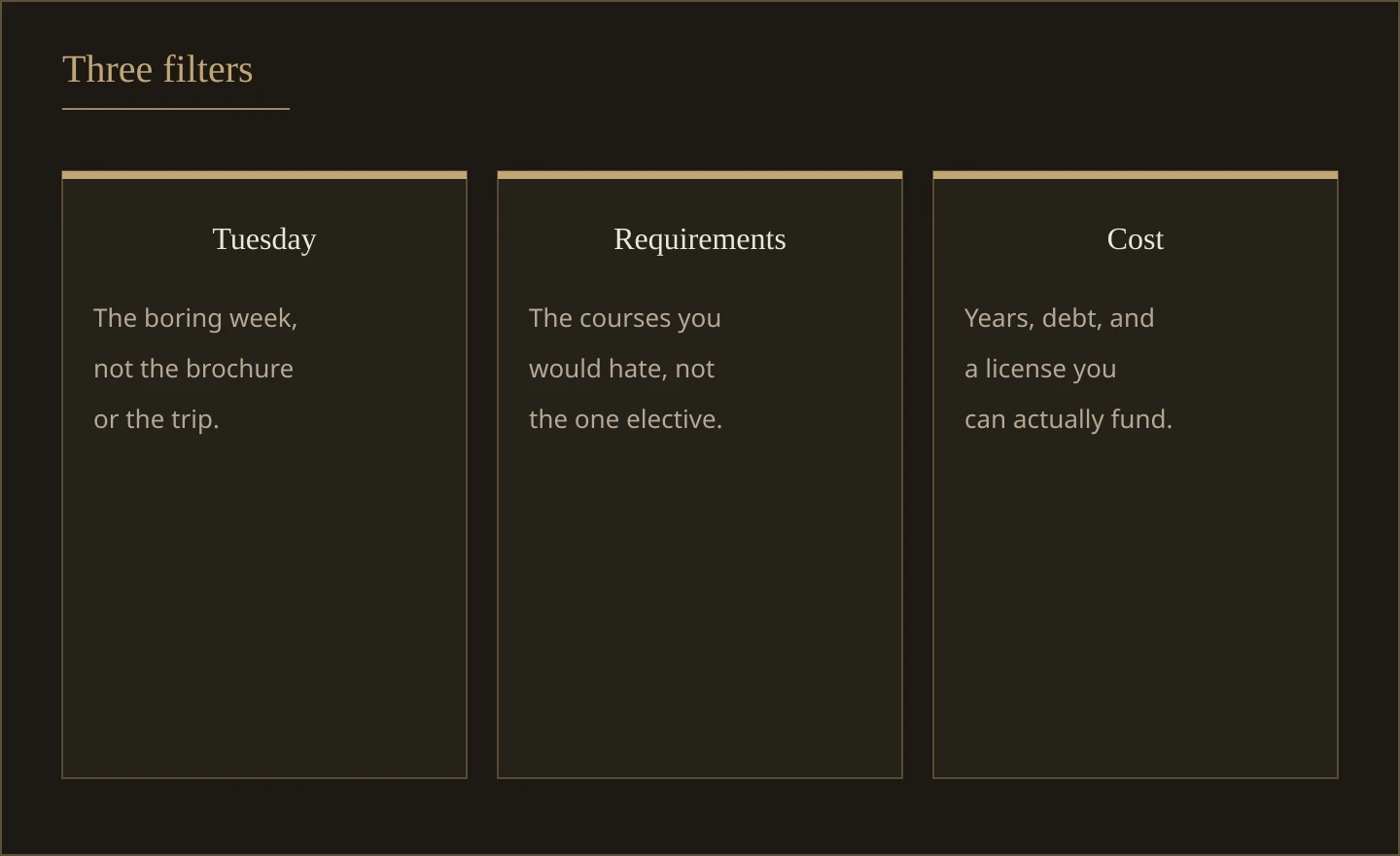
Every field has a brochure version and a Tuesday version. The brochure is the trip, the lab coat, the courtroom speech, the product launch. Tuesday is the inbox, the problem set, the charting, the revision, the shift that repeats. What should I study is mostly a question about which Tuesday you can repeat while you are still learning and not yet admired.
Ask a person in year three, or a person two years into the job, "What do you do on a boring week in February?" If they cannot answer, you are talking to the costume. If they answer and you feel relief, that is data. If they answer and you feel dread, that is also data. Interest in the costume is not a reason to sign up for the Tuesday.
Then read the requirements. Students choose majors for the one elective they liked and then meet two years of courses they would not have chosen. The requirements are the major. If you hate them in the catalog, you will hate them in the semester, and you will call the hatred a sign you picked wrong. Sometimes it is. Often it was visible before you declared.
A third filter is the exit. Some majors are literate in themselves: you can write, calculate, build a portfolio, or qualify for an entry role. Some are preludes to more school. A prelude is an honest choice when you want the later license and you can pay for the years. It is a trap when you picked it because the first part sounded broad and you never priced the second part.
How to choose a major if you are undecided
How to choose a major if you are undecided is a sequence, not a revelation.
Name two candidates, not six. Six is a way to avoid the unglamorous facts about all of them. For each candidate, write the Tuesday, the requirements you expect to dislike, the years until you can be paid, and the debt or family money involved. Drop any option that fails a hard constraint. A constraint is a wall: a cost you cannot carry, a city you will not move to, a science requirement you have already failed twice and do not intend to repeat. Arguing with a wall wastes the semester you need for a real choice.
If your school lets you test before you declare, take one course from the candidate that scares you more. Scariness is not a reason to refuse, and it is not a reason to commit. One course is a sample. Use it.
Prefer the option that keeps more than one door open only when you truly do not know. Writing, statistics, a lab science, a language, and any field that forces you to make a thing you can show are doors. "Keeps doors open" is not a reason to drift inside a major you already know you resent. A transferable skill you hate for four years is still four years.
Talk to your campus advising office for the rules, the deadlines, and the cost of changing your mind later. Rules differ. A conversation with a working adult who likes you is not a substitute for the deadline. Parents belong in the constraint conversation. They do not belong in the declaration as a veto you never examine, and they do not belong outside it if they are paying.
If the undecided feeling is really "I do not know what to do with my life," the wider check is what should I do with my life. A major is one bet inside that question. It is not the whole question.
I don't know what I want to do with my life after high school
I don't know what I want to do with my life after high school is a normal sentence. The years before this were organized for you. The years after are not. The panic is the gap, not proof that everyone else has a vocation.
You have more than one legitimate start.
Study something specific enough to practice. Not "business" as a fog, and not a hyper-narrow fantasy you have never seen up close. A subject with assignments you can be bad at and then better at. The improvement is the point. A feeling of passion is optional and often late.
Work, with a skill in view. A job that teaches you a tool, a trade, a kitchen, a shop floor, or an office is information. A job that only fills hours is also information, and it should have an end date so it does not become the default life.
A structured gap. A structured gap has a place, a task, and a date you re-enter school or work. An unstructured gap is a drift that feels like freedom until it feels like shame. If you take time, write the date.
You do not owe anyone a five-year plan at eighteen. You do owe the next year a shape. The shape can change. Shapelessness is what makes the question feel infinite.
The fork between two real options, once you have them, is how to decide between two paths without doing both at once. The pattern under the indecision, if the same freeze shows up in every choice, is who you are when a pattern repeats.
Feeling lost after college
Feeling lost after college surprises people who did everything right. The major was finished. The friends scattered. The identity "student" expired, and nobody handed over the next container. The degree is a fact. It is not a direction.
The first job is a sample of a field, not a marriage to it. Take it seriously enough to learn the Tuesday. Do not take it so seriously that a bad first seat becomes a verdict on the subject. If you hate the work after you can do it, that is evidence. If you hate it because you are new, that is the cost of being new. Learn the difference before you apply to graduate school to escape the feeling.
Another degree is the most expensive way to restore a campus schedule. It is the right cost when the work you want is licensed or genuinely requires the training, and you have checked the Tuesday with someone who finished. It is the wrong cost when you are buying a delay. Six months of paid work, even imperfect work, teaches more about the next credential than another winter of applications written from your childhood bedroom.
Feeling lost after college and feeling lost at the end of your twenties are cousins. The later version is no direction in life at 30. If what you need is a career test rather than another catalog, use how to pick a career when you are not sure. If the lost feeling is about what any of it is for, read how to find meaning in life again.
A major is a bet, not a self
At the end of the choice you should be able to say one sentence. "I am studying this for the next two years because the Tuesday is tolerable, the requirements are ones I will do, and the cost is one I can carry. I treat it as the wrong bet if I still dread the core work after a real semester."
That sentence is allowed to be revised. Changing a major early is cheaper than performing a wrong one out of pride. Staying is also a decision, not a failure of imagination. What should I study has an answer for this season. It does not have to be the name of your life.
A Meridian Reading is a structured written reading of your patterns and direction. It will not pick your major, and it is not a substitute for advising, a catalog, or a job. The sample reading shows the kind of document it is. Use it as context if the question under the form is larger than the form.
See it on the page
Explore the full sample reading in your browser, or begin your own Entry reading when you are ready.
FAQ
Common questions
How do I choose a major if I am undecided?
I don't know what I want to do with my life after high school. What should I study?
Why do I feel lost after college if I already picked a major?
What if my parents want a different major?
Continue reading
Related guides
How to find what you want to do in life, really
How to find what you want to do in life, beyond a purpose in life quiz. Use the week you have, then test one commitment you can actually keep.
How to pick a career when you are not sure yet
How to pick a career when you are not sure, including a career change after layoff. Test the work in ordinary weeks before you resign into fog.
No direction in life at 30, existential crisis
No direction in life at 30, including an existential crisis at 30, usually means the early map ran out. Change one of work, place, or people.
How to decide between two jobs or career paths
How to decide between two jobs by separating the seat, the field, and the life around them, then testing one path while the rest of life stays put.