Learn
Feeling lost at 30: finding direction
October 10, 2026
Last updated: October 11, 2026
Feeling lost at 30 means the old map expired. Rebuild direction from work, place, and people without blowing up a life that still works.
Feeling lost at 30 rarely means you have no life. It means the life you assembled to become an adult no longer tells you what the next stretch is for. The apartment is real. The job is real. The relationship is real, or the absence of one is real. And the sense of direction that carried you through your twenties has gone quiet.
That quiet is easy to treat as a personal failure. It is more often a map problem. The old map was a checklist. The checklist ended. Nobody hands you the next one, and the culture around you pretends that successful people never needed one.
Why this age hits this way
The twenties reward accumulation. First job, first city that is not your parents' city, first proof you can pay a bill, first relationship you chose with adult stakes. The goals are legible because they are shared. You can be unsure and still know the next box.
Around thirty the shared list runs out of boxes. Several things happen at once, and they feel like one crisis.
The body stops subsidizing bad schedules. Sleep, food, and recovery start to matter in a way you could negotiate around at twenty-four. A life that only works when you are indestructible starts to look like a trick.
Other people's lives become visible as structures, not as potential. Friends have children, titles, houses, or a seriousness you did not budget for. Even friends who have none of those have chosen a shape. Potential was a group activity. Shapes are individual, and comparison gets louder.
The work stops being "starting out." You are no longer new. If the job is wrong, you can no longer call it a starter job. If the job is fine, fineness is not a direction. It is a plateau with direct deposit.
A relationship either deepens into logistics or reveals that you were dating a placeholder. Both are disorienting. One asks you to become reliable in a new way. The other asks you to stop outsourcing the future to a person who was never the plan.
None of this requires a dramatic collapse. Lost at thirty is often a competent person in a life that made sense as a launch and does not make sense as a dwelling.
The checklist that was never yours
Some of the list was borrowed. A city because your friends moved there. A profession because you were good at school and this was what good-at-school became. A relationship pace because everyone else coupled on a schedule. A personality at work because the first boss rewarded it.
Borrowed is not the same as wrong. A borrowed choice can still fit. The test is whether you would choose it again with what you know now, not whether the original reason was pure. Almost nobody's original reason was pure.
Luis is thirty-one, a consultant, engaged, in a city his friends like. He is not miserable. He cannot say what the next five years are for. On paper he is ahead. In the week he is waiting for a feeling that names the point.
The useful move for Luis is not to blow up the engagement, the city, and the job in one gesture. It is to admit that the checklist is complete and therefore useless as a guide. He needs a smaller map, built from one domain. He keeps the city and the relationship steady for a season and treats the work as the open question. If the lost feeling is still the whole sky after the work has a real experiment under it, he learns that the job was not the source. That is progress. It is just sequential progress, which is less cinematic than quitting everything in March.
If the open question is the work, the practical version sits in how to choose a career path when you feel stuck. If the work is fine and the week is flat anyway, start with finding meaning in your work.
Direction is a practice, not a revelation
People wait for direction the way they wait for weather. They assume it arrives as a clear desire, preferably overnight, preferably with a job title attached. Desire is a lagging indicator. It gets specific after contact with a life, not before.
A practice you can run without a revelation:
Write the envy that names a task. Once a week, note one hour of someone else's life you wanted, and the actual activity inside the hour. Ignore the apartment in the background. After a month you have a stack of tasks. Patterns in that stack are more honest than a mission statement.
Write the relief. Which of your own hours do you hate to end? If the answer is only rest, you are depleted, and direction-talk is premature. If the answer is a kind of work, a kind of place, or a kind of conversation, that is a candidate material for the next map.
Tell the truth about depletion versus misfit. Depletion improves when you stop the leak: sleep, a boundary, a smaller social load, a project that ends. Misfit stays when you are rested. People who are exhausted call themselves lost because lost sounds more meaningful than tired. Check tired first. It is the cheaper fix, and it often gives the real question back in a form you can answer.
Choose a season length. Ninety days is long enough to learn and short enough to endure. Name one question the season answers. "Do I want more of this task?" is a question. "Who am I?" is not a question. It is a spiral.
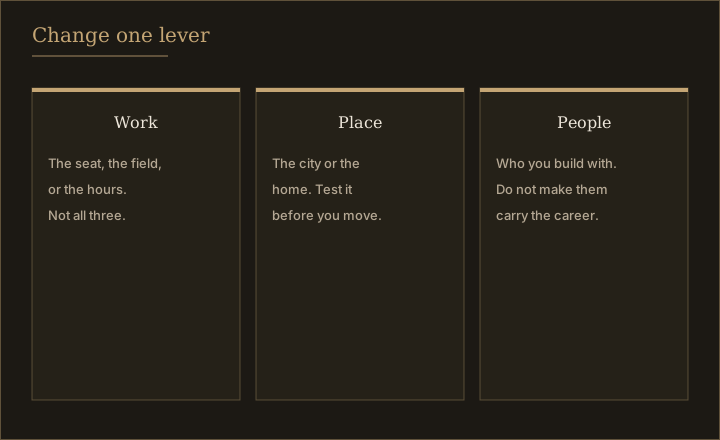
Work, place, and people are separate decisions
The fastest way to stay lost is to solve three problems with one move. A new city is asked to fix the job, the loneliness, and the story you tell at dinners. It can fix one of those. It rarely fixes all three, and when it fails you do not know which hope died.
Separate them on paper.
Work
What you do most days, and whether the next eighteen months of it are a deliberate bet. This includes the possibility that the right move is to stay and change the brief.
Place
Where you sleep, and whether that place supports the work and the people or fights them. Place is rent, weather, family distance, and whether you can be a person there on a non-special Tuesday.
People
Who you are building with: a partner, a family, a tight set of friends, or a chosen stretch of relative solitude. People decisions have the longest consequences and the worst track record as career strategies. Do not break a sound relationship to decorate a career experiment. Do not keep a hollow one because the career is unstable and you want a witness.
Pick the domain that is actually loud. Run the season there. Hold the other two as stable as you can, unless one of them is actively harmful. Harm is a different category from restlessness. Harm gets a faster response. Restlessness gets a design.
What to stop while you look
Stop collecting personality frameworks until one more label feels like a verdict. Labels are souvenirs. Your week does not change because you have a new souvenir.
Stop treating the birthday as a deadline. Thirty is a round number, not an audit. People make worse decisions in the month of a round birthday than in the month after, because the number bullies them into a gesture.
Stop asking everyone for their opinion. Three people who know your actual week are enough. A committee of acquaintances gives you the average life, and the average life is how you got a checklist that was never quite yours.
Stop quitting in clusters. One resignation, one move, and one breakup in the same season feels like honesty. It is often panic with good branding. If you truly need more than one change, sequence them and let the first one teach you before the second one spends the lesson.
Stop requiring the next chapter to justify the last one. The twenties do not need to have been a mistake for the thirties to be different. You can thank a chapter and decline to repeat it.
A smaller map
At the end of a season you should be able to say a plain sentence. "I am staying in this city, changing teams, and not making the relationship carry the question." Or: "The work is fine, the city is the problem, and I am testing one month elsewhere before I move anything." Or: "I was tired, and the lost feeling was the tiredness."
That sentence is direction. It is not a destiny. Destiny is what people demand when they are unwilling to run a season. Direction is the next season's bet, chosen on purpose, small enough to survive being slightly wrong.
If you want these questions on paper, the Crossroads Worksheet is a free decision guide you can print and share with credit.
If you want a private document that looks at this chapter as a whole, work and the rest of the pattern together, Meridian Reading is a 22-section life-path reading, reviewed individually and delivered within 48 hours, for $197 once. Each reflection is labeled Full, Clear, or Working. Use it as context for a season you still have to live, not as a substitute for the season. The definition is what a life path reading is. What the document contains is what to expect from a life path reading, and the split from astrology is life path reading vs astrology reading.
See it on the page
Explore the full sample reading in your browser, or begin your own Entry reading when you are ready.
FAQ
Common questions
Is it normal to feel lost at 30?
How do I find direction without quitting everything?
What if my friends seem ahead?
How long does feeling lost last?
Related
When your work stops feeling like you
When craft and identity fuse, skill starts to feel like a cage. How to keep the craft and change the name you answer to.
The Crossroads Worksheet: a free decision guide for choosing your next path
A free printable guide for a real crossroads: an energy audit, a values ranking, three small tests, and a ten-question self-check.
Life path reading vs astrology reading: what's the difference
An astrology reading stays in one tradition. A life path reading is a wider document about your chapter. Here is how to tell them apart before you pay.