Learn
The Crossroads Worksheet: a free decision guide for choosing your next path
October 11, 2026
A free printable guide for a real crossroads: an energy audit, a values ranking, three small tests, and a ten-question self-check.
This is a pen-and-paper guide for one decision you have been circling. It is not a personality result and it does not tell you who you are. It asks you to look at the last two weeks, rank what you refuse to starve, and design a test small enough to run without blowing up the rest of your life.
Set aside about 45 minutes. Use a real calendar, not the week you wish you had lived. One decision at a time. If you are holding a job question, a city question, and a relationship question, this page is for one of them.
Name the crossroads
Write the decision in one sentence, name what stays fixed, and pick the date you will revisit it.
A workable sentence has two live options and a stake a friend can repeat. "I am choosing between staying in this role and moving to a smaller team in the same field, and I will revisit it on the first Friday of next month." "I want a different life" is not a decision yet. It is a mood. Moods do not have tests.
What stays fixed is as important as what moves. Name the constraint you will not argue with: rent, a person who depends on the income, a visa, a body that cannot keep the old hours, a city you are not leaving this year. A constraint is a wall. Preferences can be ranked. Walls cannot.
The decision, in one sentence a blunt friend can repeat.
What stays fixed while I decide.
The date I will revisit this, whether I feel ready or not.
Run the energy audit
List the repeating tasks of the last two weeks and mark whether each one gives energy, costs energy, or is neutral.
Use tasks, not identities. "I am a manager" is not a row. "The Tuesday staffing meeting" is a row. "Sketching for an hour" is a row. "Texting a parent every night" is a row if it actually occupies the week. Include the tasks you are praised for. Praise tells you what other people need, not what to protect.
Energy here is simple. Plus means you would do it again if the money were already handled. Minus means your jaw is tight or you postpone it. Zero means you can do it without it teaching you anything. Hours matter. A task you love for thirty minutes and dread for twenty hours is a minus with a costume.
| Task from the last two weeks | Hours | Energy (+, 0, or -) | Keep, change, or drop |
|---|---|---|---|
The task I keep pretending is a plus.
The task I would protect if the title went away.
Read the minus column before you pick a new path. A new path that is built from your current minuses will feel like escape for two weeks and then feel like the old job with worse insurance.
Rank what you refuse to starve
Rank ten values, circle the top three, and note where the current path feeds or starves each one.
Rank them for the next eighteen months, not for a tombstone. A value you will not protect with hours is a compliment you pay yourself. Force a full ranking. Ties are where people hide.
- Craft you can respect when the work is ordinary
- Income that covers the real month, not a fantasy budget
- Autonomy over how the hours are spent
- A specific person who is better off because you did the work
- Learning that is still new, not a performance of mastery
- Time with the people you actually love
- Sleep, and a body that recovers
- A place you want to be on an empty Sunday
- Status you can name without embarrassment
- The ability to describe the work without flinching
My top three, in order, and one place the current path feeds each.
Which of the top three the current path starves, and how.
A value I ranked high and do not currently spend time on. That gap is data.
If the option you are leaning toward starves two of the top three, it is not your lean. It is a story about status or escape. Write that down before you tell anyone.
Design three small tests
For each live option, write a fourteen-day test with a counted result that means keep, adjust, or stop.
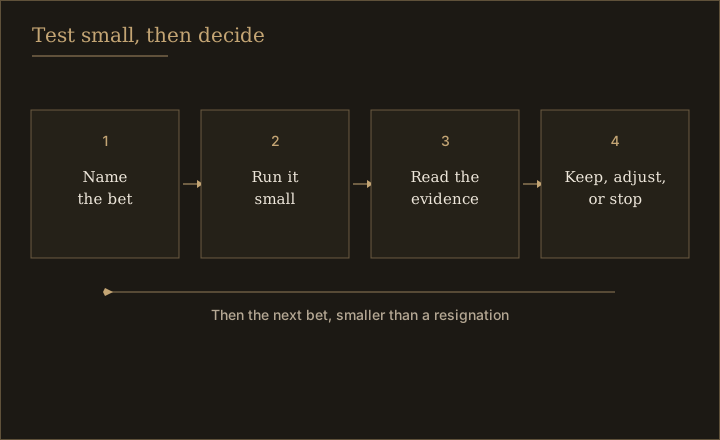
A test is contact with the work, not research about the work. Reading, saving quotes, and comparing other people's announcements do not count. A test has a person on the other end, or a finished piece of the actual task, and a number.
Fourteen days is long enough to meet the dull version of the work and short enough that you do not need to resign, move, or explain yourself to a crowd. If a test requires you to quit first, it is not a test. It is a leap wearing a worksheet.
Use at most two options. A third block is here for a parked idea you are not willing to kill yet. If you cannot describe the third test without stealing hours from the first two, leave it blank on purpose.
Option A. The smallest version of the core task, who sees it, and what I will count.
Option A. The result that means stop, and the result that means continue.
Option B. The smallest version of the core task, who sees it, and what I will count.
Option B. The result that means stop, and the result that means continue.
Parked option, and the condition that reopens it. Leave blank if you do not have one.
Example: I reopen this when I have twenty people I can contact, or six months of expenses.
Count things a skeptical friend can check. Paid yes or no. Ten conversations held. Four hours of the core task on the calendar, actually kept. A piece of work a stranger accepted or refused. "I felt aligned" is not a count.
Ten-question self-check
Answer the ten questions, then write one dated next step you can do without announcing a new identity.
Answer yes only when you can point at evidence, not when you hope the answer becomes yes after you leap. Then count the yeses.
- 8 to 10. The decision is specific enough to schedule. Do the dated step this week.
- 5 to 7. Run the fourteen-day tests before you resign, move, or tell a crowd.
- 0 to 4. You are still naming the problem. Repeat the energy audit next week before you choose.
1.Can you state the decision in one sentence another person can repeat back?
Yes / NoNote
2.Have you separated work, place, and people, and chosen only one to change?
Yes / NoNote
3.Did you list real hours from the last two weeks, not a hoped-for week?
Yes / NoNote
4.Do your top three values show up in the option you are leaning toward?
Yes / NoNote
5.Have you named a hard constraint and refused to argue with it?
Yes / NoNote
6.Is there a small test you can run in fourteen days without quitting?
Yes / NoNote
7.Does that test name a counted result that means stop?
Yes / NoNote
8.Have the people affected heard the plain version, not only the excited one?
Yes / NoNote
9.Can you say what you will still respect about this choice on a dull Thursday in month six?
Yes / NoNote
10.Is the next step a dated action, rather than a mood?
Yes / NoNote
Yes count, and which band I am in (8 to 10, 5 to 7, or 0 to 4).
Write the decision line
Copy this shape and fill the blanks. Read it out loud. If you cannot say it without adding a speech, it is not ready.
"For the next ______ months I am changing ______ and keeping ______ fixed. I treat this as the wrong bet if ______ is still true on ______."
My decision line.
The single action I will take in the next seven days, with a day and a time.
A decision line is a bet you can update. It is not a vow that the choice becomes your personality. If the stop-result shows up, you stop. That is the worksheet working.
Share this worksheet
Free to copy, print, and share this worksheet if you credit Meridian Reading and link to this page.
Print it, or use your browser's save-as-PDF, and write in the blanks. The page is the instrument. The credit line stays with it when you pass it on.
See it on the page
Explore the full sample reading in your browser, or begin your own Entry reading when you are ready.
FAQ
Common questions
How long does the worksheet take?
Do I have to quit, move, or announce anything when I finish?
Can I share or reprint this?
What if I am choosing among more than two options?
Related
When your work stops feeling like you
When craft and identity fuse, skill starts to feel like a cage. How to keep the craft and change the name you answer to.
Life path reading vs astrology reading: what's the difference
An astrology reading stays in one tradition. A life path reading is a wider document about your chapter. Here is how to tell them apart before you pay.
What to expect from a life path reading (and who it's for)
What a life path reading includes, who it helps, what it refuses to decide for you, and how to judge the document before you pay.