Learn
What to expect from a life path reading (and who it's for)
October 11, 2026
What a life path reading includes, who it helps, what it refuses to decide for you, and how to judge the document before you pay.
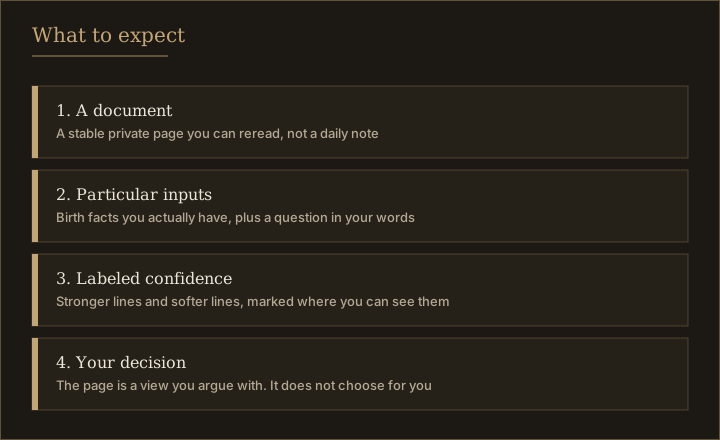
A life path reading is a private written reflection on who you are, what chapter you are in, and which directions fit the way you are built. Expect a document, particular inputs, and language plain enough to argue with. Do not expect a product to live the next year for you.
This is the practical version: what shows up, who it is for, who should skip it, and how to tell a careful one from a performance of certainty. The short definition is what a life path reading is. The split from a single-tradition chart reading is life path reading vs astrology reading.
The object, not the aura
Identify the object before the insight.
You want a stable private page, organized in sections, long enough to be specific and short enough to finish. A paragraph and a slogan is a brochure. After one read you should be able to say what it claims about your work, your close relationships, and the season you are in. If you can only say "it felt deep," you consumed a tone.
Ask for a section list before you pay, and for a sample written at the same grain as the paid piece. Read the sample for patterns, not for virtues.
What you are asked to give
The reading is only as particular as the inputs.
Exact birth date, time, and place matter whenever the method uses them. If you do not know the time, say so. A careful practice narrows what it asserts. A careless one invents precision you did not provide.
Fuller readings also ask for the name you were given at birth, the years your parents were born, where you live now, and a question in your own words. Write the question as a decision. "Should I change careers, and what am I confusing with a calling?" is usable. "Tell me my purpose" invites a poster. If a fact is uncertain, mark it uncertain.
What the document tends to cover
Practices differ. The ones worth paying usually cover the same ground.
How you are built. Attention, pace, conflict, and what you do under pressure. The test is whether someone who works with you recognizes the paragraph.
The chapter you are in. What the last stretch organized, and what this stretch asks. It names a window you can find in memory, not "a period of growth."
Work. How you do your best work, which role dulls you, and which skill you have been treating as an identity. It separates the field, the role, and the local conditions. That split is the practical problem in how to choose a career path when you feel stuck.
People. How you attach, how you withdraw, and what the people close to you experience from outside. A passage for them earns its place when it is recognizable.
Timing. Past hinges and a forward arc with restraint. It marks seasons that deserve planning, and it says how firm the mark is. It does not narrate your future as fact.
Your question, in one place. The document should meet what you asked, in proportion to the evidence. If the question is whether to leave a job and start a company, the answer still has to respect money, dependents, and the difference between a real idea and an exit. The decision framework is should I quit my job to start a startup. The fit of the idea is which startup idea is right for you. A reading is a third input, not the resignation.
What it declines. Room for a lower-confidence label, or for silence. A page where every line is equally certain has not done the work.
How confidence should be labeled
Honest interpretation has stronger and weaker claims. The stronger ones agree across more than one angle and match the inputs cleanly. The weaker ones are real enough to mention and too soft to steer a life. A careful document labels the difference where you can see it.
One way is a small set of labels used the same way in every section. Full means the claim cleared a high bar. Clear means the direction is readable and still yours to weigh. Working means the pattern is present and less defined: context, not a command. The names can vary. The behavior cannot. If everything is full, nothing is.
Lean on the high-confidence lines. Use the softer lines as questions. If the provider will not say which is which, you are supplying the confidence and they are supplying the adjectives.
Who it is for
It earns the cost when you are in a threshold and you want a structured outside view you can mark up.
The work looks acceptable and feels like a previous version of you. Finding meaning when the job looks fine is the companion for telling a missing ingredient from a wrong container. A reading describes the work you sustain. It does not install a feeling.
You are good at something that has become the only name people use for you. That knot is when your work stops feeling like you. A reading can show the gap between the posture you are in and the one you sustain. It should not order a resignation.
The early map has run out, and the job, the city, and the relationship are still real. Feeling lost at 30 is about a smaller map. A life path reading helps when it treats the chapter as a whole, including a decision whose date is already on the calendar.
Who it is not for
Skip it when the actual request is something else.
You want a daily note or a costume for a group chat. Those are different products.
You want a diagnosis, a legal position, or a financial strategy. A reading is not care and not counsel.
You want someone else to pick the job, the partner, or the city so the blame has a home. A reading that promises a specific event next year is overselling. The adult use is narrower: here is the pattern, here is the season, here is what would count as aligned. The move stays yours.
You are collecting frameworks and you have not run a ninety-day test. Run the test. The document keeps.
Your facts are approximate and you want full specificity anyway. Pay for the resolution your facts support.
What happens after you order
You complete an intake once. Facts, question, stop. You are not joining a content habit.
A person finishes the document. "Individually reviewed" means someone applies judgment before delivery: what is strong enough, what is too soft, what would be irresponsible. A same-second reply is a clue that no one stood between the draft and your name. A wait of hours or a couple of days is ordinary for work that is actually finished.
Read it once without hunting for your question. Then read the question. Then set it down.
On the second read, mark three kinds of lines: ones that match a fact you can point at, ones that conflict with a fact, and ones too vague to mark. If the vague lines dominate, that is the provider's problem. If a line conflicts with a fact, that is your protection against obedience.
Use it on one decision. Change one variable. People who change job, city, and relationship in the same month because a document felt urgent are using permission, not a reading.
Return when the next decision arrives. The document should still say what it said. By then you have new evidence. Update the bet. Do not ask the file to grow a new personality every week.
How to judge one before you pay
There is a sample in the same form as the paid reading.
Inputs are named, and missing inputs change what they claim.
Confidence is labeled, or weak material is left out. Not a page of equal-strength adjectives.
A human reviews the finished piece, and says so.
The language is plain. A life path reading that keeps a private dialect and also claims to be plain is doing neither job.
There is a refusal list: no medical claims, no legal claims, no guaranteed outcomes, no countdown. A larger tier, if it exists, is more contact or more frequency, not the unlocked version of your own life.
How to read it when it arrives
Read on a day you are not performing a crisis. Read for behavior, not for compliments. Compliments are how thin work survives.
Show one section to one person who sees your actual week. Ask what matches. Believe the overlap.
Then do one small thing the high-confidence lines describe as fitting, and watch a month. Not a reinvention. A month.
A finished example
Meridian Reading is one version of this category. You receive a private 22-section document, reviewed individually, delivered within 48 hours, for $197 once. Each reflection is labeled Full, Clear, or Working. It is a mirror of a chapter, for personal reflection, not medical, psychological, financial, or legal advice, and not a command to change your life on the day it arrives.
The sample reading is the full shape. Read it against the standard in this piece: object, inputs, labeled confidence, and sentences you can test on a week you already lived.
See it on the page
Explore the full sample reading in your browser, or begin your own Entry reading when you are ready.
FAQ
Common questions
What do I actually receive?
Who is a life path reading for?
How long does it take, and how do I use it?
What if a section does not sound like me?
Related
When your work stops feeling like you
When craft and identity fuse, skill starts to feel like a cage. How to keep the craft and change the name you answer to.
The Crossroads Worksheet: a free decision guide for choosing your next path
A free printable guide for a real crossroads: an energy audit, a values ranking, three small tests, and a ten-question self-check.
Life path reading vs astrology reading: what's the difference
An astrology reading stays in one tradition. A life path reading is a wider document about your chapter. Here is how to tell them apart before you pay.