Learn
Life path reading vs astrology reading: what's the difference
October 11, 2026
An astrology reading stays in one tradition. A life path reading is a wider document about your chapter. Here is how to tell them apart before you pay.
People search "life path reading" and "astrology reading" as if the phrases were two labels for one purchase. They can share a birthday, an interest in timing, and a person who interprets both. They part ways on scope, on vocabulary, and on whether you are buying a tradition or a document about a chapter of your life.
If you are about to pay, ignore which phrase sounds more serious. Look at the object you hold when the work is done, and at what that object is allowed to refuse to say.
What you are actually buying
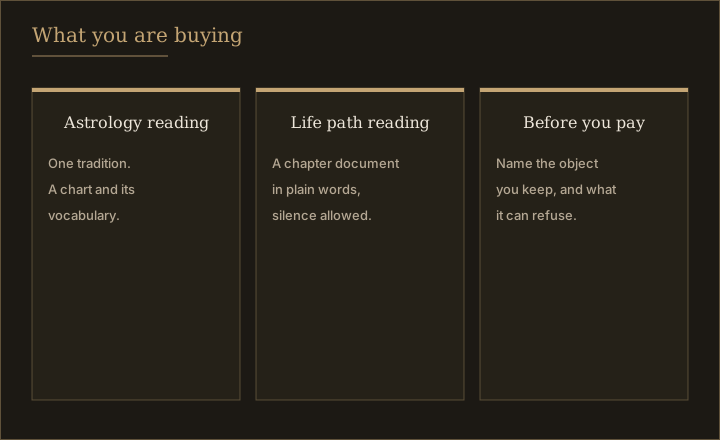
An astrology reading is an interpretation inside one tradition. The tradition has rules for birth date, birth time, and birthplace. The usual object is a natal chart: a map of symbolic positions, read by someone trained in that map. You leave with an explanation. That explanation can be a live hour, a PDF, or a stream of short notes in an app. The home of the work stays astrology.
A life path reading is a category, not a tradition. It is a structured account of who you are, what season you are in, and which directions fit the way you are built. It can draw on astrology. It can draw on other inputs. The thing you should be able to point at is a document you reread when a decision shows up, not a dialect you have to keep studying in order to remember what was said.
The category is defined in what a life path reading is. This piece is the buying comparison.
What an astrology reading is built to do
A serious astrology reading is specific to a moment of birth. Two people born on the same day in different cities, or a few minutes apart, do not get the same chart. A sun-sign column is not an astrology reading. A reading that uses your time and place is, and it teaches you that tradition's grammar on your own chart.
It also inherits the tradition's blind spots. Every lineage underweights something: vocation, or the people you live with, or the plain description of a Tuesday. You receive the strengths and the omissions together. That is what a single lens does.
A daily note or a feed of friends' charts is still this category. Those products are built to be opened often. They are not the document you take into a career decision.
What a life path reading is built to do
A life path reading starts from a question about a life, not from loyalty to one grammar.
The questions are ordinary and large at the same time. Is this the work, or only this job? Is this city the problem? What stretch of earlier years still organizes my choices?
The better readings answer in a form you return to. They are written, sectioned, and allowed to stay silent where the inputs do not support a claim. They tell you how much weight a line deserves.
Inputs are often wider than a chart. Birth data still matters when the method uses it. So can the name you were given, the years your parents were born, the place you live now, and the question in your own words. The extra facts stop the reading from treating you as a birth moment with no family and no present city.
The output is a chapter document: how you are built, what period this is, what speeds you up or shuts you down, how the people close to you experience you, and where the next stretch is asking for a decision. You can disagree. Disagreement is easier when the sentences are plain and the page stays put.
The walkthrough of that document is what to expect from a life path reading. The rest of this piece stays on the comparison.
Where they overlap
Both can ask for date, time, and place of birth, and both can talk about timing. Both attract people in a transition who want an outside view that is not a friend's advice and not a Tuesday quiz.
Both fail the same way: vague praise, a flattering story, no sentence that says "this part is weak." The category name does not protect you. Ask who reviews the document, and what happens to a claim the reader does not trust.
Where the work diverges
Scope. An astrology reading answers to a tradition. A life path reading answers to a question about your life. The first can be excellent and never mention the job you are deciding whether to leave. The second can be excellent and refuse to teach you the names of aspects. You are choosing which responsibility you want.
Language. Astrology readings often keep the tradition's vocabulary on the page. That is a feature when you want to learn the map, and a cost when you wanted a paragraph you can read without a glossary. A life path reading, at its best, leaves the symbols in the workshop and speaks in ordinary words: work, attention, conflict, timing, the people who know you.
What is allowed to be missing. A single-tradition reading has to account for the chart, so silence can look like a hole in the craft. A life path reading that uses more than one input follows a different rule: if the inputs do not agree, the finding does not headline the page. You trade some completeness for a higher bar. Neither trade is free.
The object you keep. A session lives in memory and in notes. An app lives in the habit of checking. A life path reading is a private document with a stable address. You should open the same section in March and in October and find the same sentences. If the product changes every morning, you bought a feed.
The question it holds. "Explain my chart" is an astrology question. "I keep confusing the role with the field" is a life-path question, and so is "I do not want to blow up a life that still works." Those have their own guides: how to choose a career path when you feel stuck and feeling lost at 30. A reading informs the decision. It does not make it.
Time horizon. Daily astrology products are built for this week. A life path reading is built for a chapter: the last several years, the season you are in, the next stretch you can plan. A notification and a mirror are different purchases.
A shorter companion on this site treats astrology as one tradition and a life path reading as a category. A three-way comparison with personality tests is life path reading vs natal chart vs personality test.
How to tell them apart before you pay
Read the sample, not the slogan. Both categories borrow the same marketing words. The sample shows the grain of the work.
Ask for concrete answers.
What do you receive? A live hour, a PDF, a web document, an app login? How long is it, and do you keep it?
What inputs change the result? If no one can say what happens when birth time is missing, they are guessing and calling it personal.
Is the work inside one tradition, or does it cross-check more than one reading of the same facts? One tradition is a legitimate choice. Pretending it is a synthesis is not.
Who finishes the document? "Individually reviewed" means a human applies judgment before you see it. If no one says that out loud, assume it does not happen.
What do they decline? Medical diagnosis, legal advice, a command to leave a job or a marriage, claims that miss their own bar. A practice with no refusals is selling confidence.
Can you test a sentence against last month? "You are a natural leader" cannot be checked. "You do your best work on one hard problem, and you go dull in a calendar of other people's meetings" can.
Price is a weak signal. Look at the object and the refusals.
Who each one is for
Choose an astrology reading when you trust that tradition, or you want to learn it, and you are not asking for a career memo.
Choose a life path reading when you want a structured outside view of a chapter: work that has gone flat, a company you are tempted to start, a skill that has become a cage. The practical companions are should I quit my job to start a startup, which startup idea is right for you, finding meaning when the job looks fine, and when your work stops feeling like you. A reading is context. The choices stay yours.
Skip both when you want a diagnosis, a legal strategy, or someone to blame the decision on.
What to do with the result
Read once for recognition and a second time for friction. Mark the lines that name a pattern you have been explaining away. Give it two ordinary weeks, and see whether the description matches an actual Tuesday. Keep the sentences you can observe. Do not adopt the result as a new identity.
Where Meridian sits
Meridian Reading is one life path reading, not an astrology feed. You receive a private 22-section document, reviewed individually by a human, delivered within 48 hours, for $197 once. Astrology is one input among others. Findings that miss a high bar stay out. What remains is labeled Full, Clear, or Working, so you can see how hard to lean. It is for personal reflection, not medical, psychological, financial, or legal advice.
The sample reading is the full scroll. Test it the way you would test anyone else's work: against a week you actually lived.
See it on the page
Explore the full sample reading in your browser, or begin your own Entry reading when you are ready.
FAQ
Common questions
Is a life path reading just another name for an astrology reading?
Do I need both?
Do both need an exact birth time?
Which one is more accurate?
Related
When your work stops feeling like you
When craft and identity fuse, skill starts to feel like a cage. How to keep the craft and change the name you answer to.
The Crossroads Worksheet: a free decision guide for choosing your next path
A free printable guide for a real crossroads: an energy audit, a values ranking, three small tests, and a ten-question self-check.
What to expect from a life path reading (and who it's for)
What a life path reading includes, who it helps, what it refuses to decide for you, and how to judge the document before you pay.