Learn
Finding meaning when the job looks fine
October 9, 2026
Last updated: October 11, 2026
When the job looks fine and still feels flat, meaning is a fit problem. How to locate what is missing, and what to change first.
Finding meaning in your work is a strange problem when the job looks fine on paper. The pay is fair. The title is one your family can repeat. The people are not cruel. Nothing is on fire. And Sunday evening still sits on your chest.
That gap is easy to dismiss, including by you. Other people have worse jobs. You have health insurance. You tell yourself to be grateful, and the gratitude is real, and the flatness does not leave. Gratitude and fit are different facts. You can hold both.
Fine on paper, flat in the week
Paper measures what other people can verify: compensation, brand, promotion speed, a calm Slack. The week measures something else.
Notice three signals that are more precise than "I feel empty."
Specific envy. You do not envy a person's vacation. You envy a particular hour of their work. A friend who spends the morning in a clinic. A former classmate who still builds the thing with their hands. Envy that names a task is information. Envy that names a lifestyle is usually advertising.
Relief. Which hours do you hope will not end? Not the lunch, the actual work hour. If you cannot find one in the last month, the week is not feeding you. If you can find one, and it is a small slice, that slice is the clue. Protecting it matters more than reinventing your whole life around a mood.
The story problem. You can describe your job, and you do not want to. Not because it is secret, and not because you are humble. Because the description has no point of contact with what you respect. You are not ashamed. You are absent.
If none of these show up, and you are mostly tired, start with load. Overwork counterfeits a meaning crisis. A job with no slack feels meaningless because you never meet the work. You only meet the queue. Cut load before you cut the career.
Meaning is a fit, not a mood
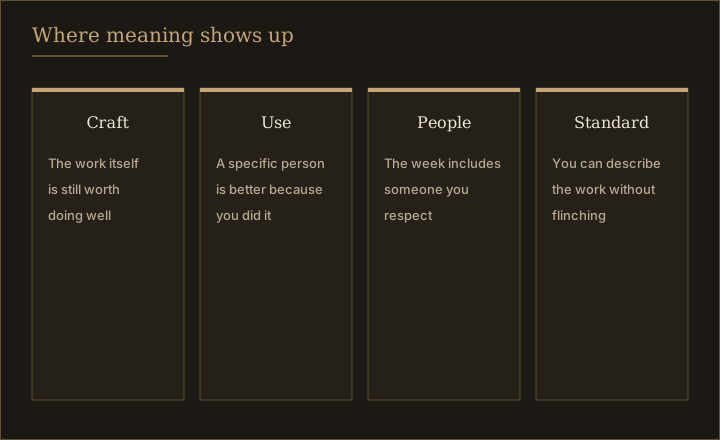
Meaning is not a feeling you wait to receive, and it is not a personality type. In ordinary work it comes from fit between the week and a few sources that are allowed to be plain.
Craft
The work gets more precise in your hands. You can tell a good version from a sloppy one, and you care about the difference when nobody is grading you. Craft meaning is quiet. It shows up as irritation at a shortcut you used to accept.
Use
Someone who is not you is better off because the thing exists. A customer, a patient, a reader, a colleague downstream, a public that never learns your name. Use meaning collapses when you cannot trace the line from your Tuesday to their outcome. Some jobs hide that line under process. Some jobs never had the line.
People
The group is one you respect on an ordinary Wednesday, not only at the offsite. You would take a hard problem to them. You are not performing closeness. People meaning is real, and it is also the easiest to fake yourself out with. A kind team can keep you in work you have outgrown for years. Thank them, and still look at the work.
Standard
You are proud of how it is done. The materials, the honesty of the claim, the refusal to ship the cheap version. Standard meaning is what people lose first in jobs that reward speed and punish care. They still have craft skill. They spend it on something they no longer sign in their head.
A solid job often has one of these and lacks the others. The mistake is to treat a missing source as proof that you need a new identity. You may need a missing ingredient. Craft versus identity is the piece to read when the missing piece is "this work is fine, and it is no longer the name I want."
The promotion that moves you off the work
A common way for a fine job to go flat: you get better, and the organization promotes you out of the source that made the job make sense.
Management is a real craft. Making other people effective, holding a standard, unblocking a team, telling the truth about a date. Some people come alive there. If that is you, the promotion is not the problem. Loneliness at the new altitude eases with peers, not with a retreat to your old tasks.
If it is not you, the promotion is a trade you did not notice you accepted. You traded craft or use for status and a different kind of people-work. The paper improves. The week gets louder and thinner. Colleagues congratulate you. You have no clean sentence for why it feels like a loss, so you call it gratitude failure.
You can sometimes undo this without drama. A lateral move back toward the work. A role that keeps the senior title and returns a fixed share of the week to the original craft. A smaller organization where senior people still do the thing. Say what you want in operational language: "I want two days a week on the work itself, and these three meetings go to someone who wants them." Organizations answer operational sentences. They freeze when you say you are searching for meaning.
How to test a change without burning the job down
Pick the thinnest source. If you already know which of the four is missing, aim at that one. If you do not, use the envy and relief notes from the last month. They usually point at a task, and the task points at a source.
Then renegotiate a slice of the week before you resign. Twenty percent is a useful size. One day, or four deep hours, aimed at the missing source. Examples that are boring enough to be real:
A hospital administrator who misses clinical problems takes one project that sits next to patient flow, or a regular half-day on a unit, instead of quitting into a degree they have not tested.
A brand strategist who misses making takes a recurring production block and stops treating craft as what happens after the deck is approved.
An engineer who misses use spends a fixed afternoon with support or with a customer, and changes one thing those people actually hit.
Run the slice for six to eight weeks. Then review it the way you would review a project, not a feeling.
Did the missing source show up in the slice, or did you merely get a break from email?
Do you want more of that slice, enough to trade status, money, or convenience?
Can this organization hold that work, or did the slice survive only because you hid it?
If the slice works and the organization can hold it, expand it. That is meaning without a resignation. If the slice works and the organization cannot hold it, you have a target for the next seat: a job where that source is the job, not a hobby you defend. How to choose that seat is a different problem, covered in how to choose a career path when you feel stuck.
If the slice does nothing, you learned that this particular guess was wrong. Try the next source once. Two failed slices are enough. After that, more experimentation inside the same wrong container is delay.
What not to do with the flatness
Do not collect frameworks until one of them feels like a verdict. A verdict from a quiz is a costume change. Your week is still there on Monday.
Do not require the job to carry your whole life. Friendships, place, body, and private projects are allowed to hold meaning the job never will. People who demand that work be the entire point often destroy a decent job chasing a total answer. If the flatness is everywhere, not only between 9 and 6, the work page is the wrong tool. Start with sleep, health, and whether the rest of life has gone thin.
Do not shame the part of you that wants the work to matter. A fine job that leaves you absent is a real problem. It is just a specific problem. Specific problems have next moves. "My life is wrong" does not.
Meaning shows up in the week or it does not. You can build a week with more of the source you actually respond to. You cannot think your way into a feeling and then schedule it later.
If you want these questions on paper, the Crossroads Worksheet is a free decision guide you can print and share with credit.
If a private document would help you see the pattern of what kind of work fits this chapter, Meridian Reading is a 22-section life-path reading, reviewed individually and delivered within 48 hours, for $197 once. It does not install meaning. It gives you something stable to argue with while you change the week. Start with what a life path reading is, then what to expect from a life path reading and life path reading vs astrology reading.
See it on the page
Explore the full sample reading in your browser, or begin your own Entry reading when you are ready.
FAQ
Common questions
Why does a good job still feel empty?
Do I need a calling for work to mean something?
Can I find meaning without changing jobs?
How do I know this is a season and not a wrong life?
Related
When your work stops feeling like you
When craft and identity fuse, skill starts to feel like a cage. How to keep the craft and change the name you answer to.
The Crossroads Worksheet: a free decision guide for choosing your next path
A free printable guide for a real crossroads: an energy audit, a values ranking, three small tests, and a ten-question self-check.
Life path reading vs astrology reading: what's the difference
An astrology reading stays in one tradition. A life path reading is a wider document about your chapter. Here is how to tell them apart before you pay.