Learn
How to choose a career path when stuck
October 5, 2026
Last updated: October 11, 2026
Separate the role from the field, test the work in ordinary weeks, and choose a career path with your real constraints in view.
Choosing a career path when you feel stuck is less about finding a hidden calling and more about getting honest about the work already in your week. Stuck usually means the current work no longer teaches you anything, and the next step on the ladder does not either.
A bad quarter, a manager who cannot decide, and a field you have outgrown all feel the same on a Sunday night. They ask for different moves.
What "stuck" tends to mean
People say they feel stuck and mean at least one of these.
The work repeats. You can do the core of the job from memory, and nobody is asking for the part you are best at.
The next promotion moves you away from the work. The reward for being good at the craft is a calendar full of other people's problems.
The field still interests you, and this seat does not. You like the problems. You do not like the way this company, this team, or this client mix uses you.
The life around the job has changed. A parent to care for, a city you no longer want, a partner's career, a body that cannot keep the old hours. The job did not get worse. The fit did.
Name which one is yours before you open a job board. A person who is bored inside a good field needs a different search from a person who is done with the field.
A seat problem wearing a field problem's clothes
Maya is a product designer at a health company. She is good at the work. Her manager wants her to "own the roadmap," which in practice means twelve stakeholder meetings and almost no time in the file. She tells friends she wants to leave design. What she wants is to leave the meeting version of design.
One path throws away a decade of skill. The other changes the seat. The job title and the field share a word, so most people in her spot only see the first.
Separate the role from the field
Write two lists on paper, not in a notes app you reorganize instead of finishing.
On the first list, put tasks from the last month that you would do again if the money were already handled. Be strict. "I like my team" is not a task. "I like the sketching hour on Wednesday" is. "I like untangling a messy account until the numbers agree" is.
On the second list, put tasks you postpone, delegate, or finish with your jaw tight. Include the ones you are praised for. Praise tells you what the organization needs, not what to keep doing for ten years.
Then sort each task into field or role.
Field is the subject: buildings, numbers, patients, software, food, law, classrooms, logistics.
Role is the posture: maker, seller, fixer, teacher, manager, analyst, founder, operator.
Most stuck people try to change both at once, which is why the search feels infinite. Change one variable first.
If the field still pulls you and the role does not, look for the same subject in a different posture. The designer who is tired of facilitation looks for a studio, an in-house craft seat, or a smaller company where the designer still draws. The analyst who is tired of decks looks for a seat closer to the decision, or a research role with fewer performances.
If the role still fits and the field does not, keep the posture and change the subject. Vocabulary is learnable. A posture you dislike is the harder thing to fake for a decade.
If both lists are nearly empty, the problem is larger than a career path. Sleep, health, and a life with no slack flatten any job. Repair the floor before you interpret the flatness as a vocation crisis. When the job is only one room in a house that no longer fits, feeling lost at 30 is the closer frame, even if you are not thirty.
A test that uses ordinary weeks
Interest is cheap. Evidence is a week in which you do the work and want the next week of it.
Pick two candidate paths, not six. For each path, design a small trial you can run without quitting.
Shadow one afternoon with someone who does the unglamorous version of the job, not the conference version. Kitchens, site trailers, on-call rotations, and closing shifts tell the truth. Panels do not. Or ship one small piece yourself: a reported article, two Saturdays on a job site, one full outreach cycle that includes the no.
Ask for the bad parts by name. "What do you do on a boring Tuesday in February?" is a better question than "Do you love it?" People who love their field still have Tuesdays. If they cannot describe one, you are talking to the costume, not the job.
How to score the test
Score the trial on three lines, after you have done it, not before.
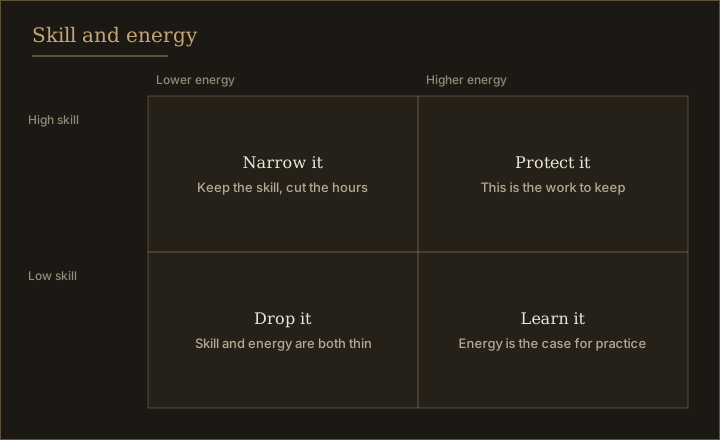
Energy. Did the hours leave you more awake or more used up, once the novelty faded? Nervous excitement on day one does not count. The third session does.
Skill. Did you improve at a visible rate, or did you only enjoy being a beginner? Beginner enjoyment is real and it expires. A path you respect is one where the next unit of skill is obvious and you want it.
Constraint. Can this path pay your actual bills on a timeline you can survive? Include health insurance, dependents, debt, and the city you refuse to leave. A path that fails constraint is not a moral failure. It is a path you cannot choose yet. Keep it as a side practice, or stage it: a year of savings, a cheaper city, a partner's income for a defined window, a bridge role that moves you closer. Pretending the constraint is not there is how people quit into panic.
How to choose when every option looks reasonable
Some people are not short of options. They are short of a rule. If you can picture three respectable lives, use this order.
Drop any option that fails a hard constraint. Geography, money, caregiving, a visa, a non-negotiable health limit. These are walls, not preferences. Arguing with a wall wastes the season you need for the real choice.
Among what remains, prefer the option that uses the tasks from your first list on most days, not as a hobby you promise to protect and then abandon in month two.
Prefer the option you can test in ninety days. A path you cannot sample is a fantasy with a salary band attached. If two options tie, pick the one that is easier to reverse. A new team in the same field is easier to undo than a three-year credential.
Write the choice in one sentence you can read on a tired Thursday: "I am choosing this path for the next eighteen months because of this reason, and I treat it as the wrong bet if this observable thing is still true." Eighteen months is long enough to get past the beginner haze. "I feel fulfilled" is not an observable failure. "I still dread the core task after six months of real practice" is.
What to do in the next month
Keep the current job while you run the test, unless the job is harming your health or your integrity. Quitting in order to "get clarity" trades a known problem for an open one, and open problems are expensive. Clarity is mostly a byproduct of contact with the work, not of free time.
In the next month, ignore the rest of the advice industry and do two things.
Tell one person who has seen you work, not one person who likes you. Ask which tasks they would hire you for again. Believe the overlap between their answer and your first list.
Block four hours a week for the test. Put it on the calendar the way you would a client. If you cannot protect four hours, you do not yet have a path problem. You have a time problem, and a new career does not create hours. It spends them.
When staying is the honest choice
Stay, and change the brief, when the field and the role are right and the local conditions are wrong. That can mean a new team, a new client mix, a written limit on meetings, or a project you pitch that uses the tasks on your first list. Staying with a changed brief is a decision. Drifting is not. If you stay, write the brief down and review it in ninety days. An unwritten stay is just inertia with a nobler name.
Leave the field when you have evidence from the week-level test, a constraint plan that survives contact with rent, and a sentence you can say out loud. You can be unsure about year five. You cannot be vague about the next eighteen months and call that openness.
If you want these questions on paper, the Crossroads Worksheet is a free decision guide you can print and share with credit.
Career choice is a bet you update, not a personality result you discover once. If you want a structured outside view of the chapter you are in, rather than another list of job titles, Meridian Reading is a private 22-section life-path document, reviewed individually and delivered within 48 hours, for $197 once. Reflections are labeled Full, Clear, or Working, so you can see how hard to lean on a line. For what that kind of document is and is not for, read what a life path reading is. The split from an astrology reading is life path reading vs astrology reading, and the contents and the fit are in what to expect from a life path reading.
See it on the page
Explore the full sample reading in your browser, or begin your own Entry reading when you are ready.
FAQ
Common questions
How do I choose a career if I have too many interests?
Is it too late to change careers?
Should I quit before I know the next path?
How do I know if this is a bad week or a bad fit?
Related
When your work stops feeling like you
When craft and identity fuse, skill starts to feel like a cage. How to keep the craft and change the name you answer to.
The Crossroads Worksheet: a free decision guide for choosing your next path
A free printable guide for a real crossroads: an energy audit, a values ranking, three small tests, and a ten-question self-check.
Life path reading vs astrology reading: what's the difference
An astrology reading stays in one tradition. A life path reading is a wider document about your chapter. Here is how to tell them apart before you pay.