Learn
Career crossroads: how to choose your next move at work
October 20, 2026
Career crossroads, explained: the four moves you can make at work, how to test one for a season, and what to keep steady while you decide.
A career crossroads is a choice among ways of working, not a verdict that the last choice was a mistake. Staying, climbing, shifting lanes, and leaving the field can all look open at once. Name which of those four you are actually weighing. Then test that one for a season, with money and the rest of life held steady.
This page is the work version of a fork. If quit, a move, and a change of field are tangled together, separate them in which path to choose when the next step splits. If you want the decision on paper first, use how to make a big life decision at a crossroads. The wider shelf is career and work. The whole library is start here with every guide.
What a career crossroads is, and what it is not
A career crossroads is the point where more than one next move at work is still available, and none of them is obvious from the title you already have. It is a decision with a date. It is not a crisis, and it is not proof you chose wrong the last time.
The feeling is usually narrower than a ruined life. The role got smaller than the skill, the ladder asks for work you do not respect, a neighboring lane uses the same difficulty, or the field no longer matches the problem you want a decade on. Naming the wrong one sends you to school, or to a resignation, for a problem a rewritten Tuesday would have answered.
The Yale Office of Career Strategy already publishes the order: look at interests, values, and skills; research real options; evaluate them; try one; then reflect. Yale is plain that an assessment cannot tell you what to do. It only suggests where to look. A crossroads that skips the try step becomes a mood with a draft resignation.
The four moves
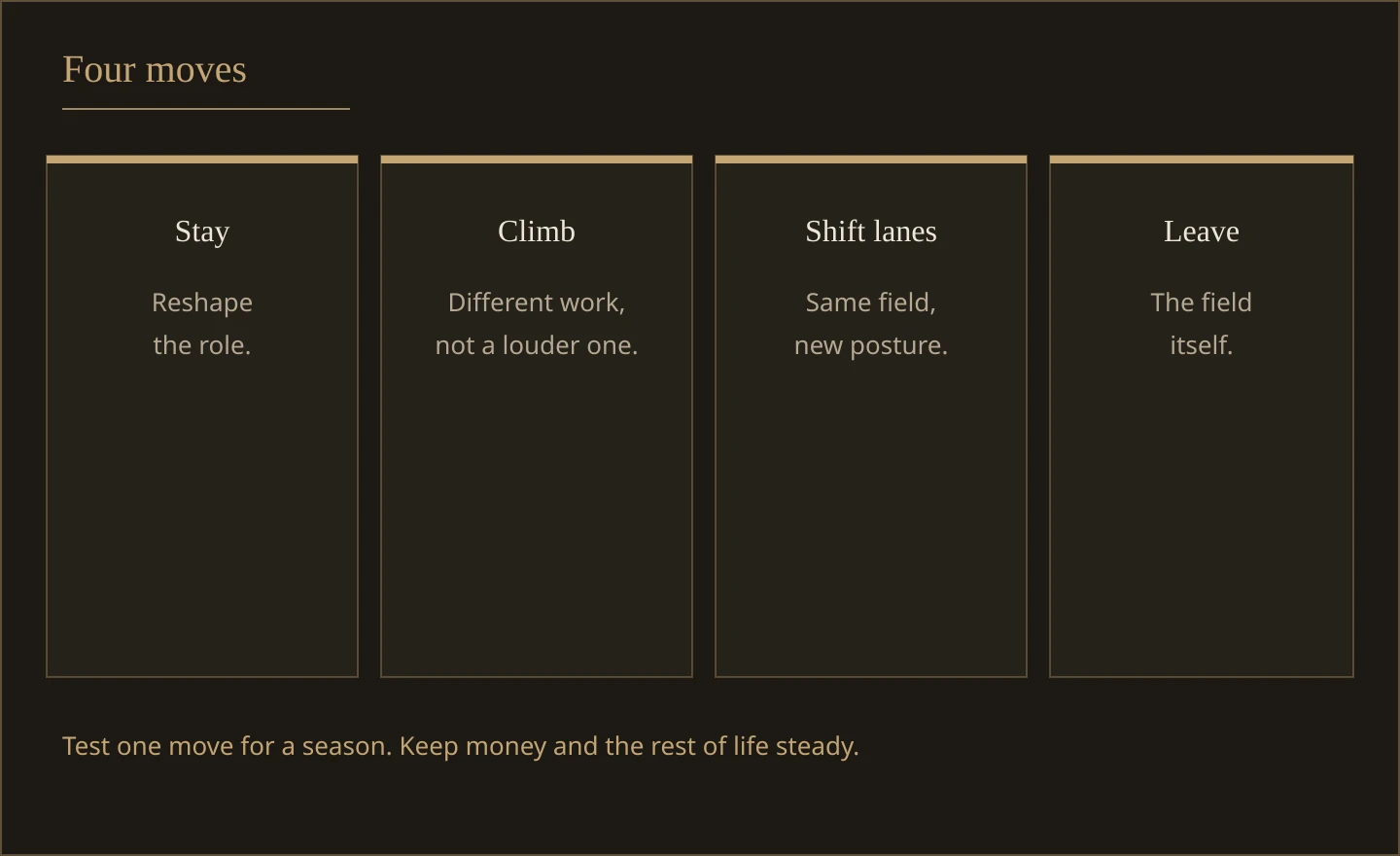
Hold the list to four. More than four is usually a way to avoid the unglamorous work on any of them.
Stay and reshape the role. The field and the seat are mostly fine, and one slice of the week is wrong: the meeting that eats the craft, the clients you did not choose, the title that hides the work. Rewrite the scope, change the manager, or protect a block of hours. This is the easiest move to reverse.
Climb. The next level is different work, not a louder version of this one. Write that Tuesday before you call the climb a reward. A climb that trades the task you respect for other people's calendars is a costume unless you want that trade.
Shift lanes inside the field. Same subject, different posture: maker, seller, fixer, teacher, manager, founder. How to pick a career is the filter once those lanes have names.
Leave the field. The subject itself is the problem. The move needs a new vocabulary and often a new network. It is also what people choose when they are tired of a boss. If a tool took the routine layer of the job, read what to do if AI takes your job before you condemn the field.
Write: "The move I am actually weighing is ____." If you cannot finish it, you have a complaint, not a crossroads. Complaints do not have tests.
Is it the work or the season?
Some crossroads are the tasks. Some are the chapter. The tasks version has a specific hour you dread or would protect if the title went away. A different seat in the same field would remove that hour, and you still respect the subject on a dull Thursday.
The chapter version is wider. The calendar changed, the people who needed you changed, or a previous answer went quiet, and the job is the nearest object to blame. What chapter of life you are in is the check. Solving a chapter with a career costume recreates the chapter in a new office. If both are true, test the task change first. It is cheaper.
Score the options before you feel them
The new option is always more vivid than the one you already know, so feeling is a poor sorter. 80,000 Hours treats the choice as a written comparison: a few criteria, a score, and a note about what would change your mind. Their checklist for assessing options is the prompt. You need the habit of scoring before you announce.
Pick three to five criteria for the next eighteen months: the ordinary tasks, the money you can survive on, the on-ramp to the first real month, how hard the move is to undo, and who else pays if you are wrong for a season. Score each live move from 1 to 5. Then write: "I would abandon the leader if ____ showed up by ____." A score without that line is a preference.
UNC Kenan-Flagler frames career choice and career change as a process you revisit, not a single brave hour. If two moves tie, prefer the one that is easier to reverse. A reshaped role is easier to undo than a credential. A lane shift inside a field you know is easier to undo than a field you have never worked in.
Test one move for a season
Yale's try step is contact with the work, not research about the work. Three to six months is the usual window: long enough to meet the dull version, short enough that you do not need a new identity to run it. Use a shorter window for ten conversations, and a longer one only if a license or a hiring cycle forces it.
A real test is a project inside the current job that uses the new tasks, a bridge role of a few hours a week, a class that includes the boring work, or ten conversations with people who do the unglamorous version. Write the question before you book them.
Write the stop result before you start. "I still dread the core task after I have done it four times" is a result. "I feel unfulfilled" is not, until you can point at the hour that produces it. Count hours kept, a piece of work accepted or refused, or a yes or a no from someone who does the job.
Do not quit in order to run the test. A resignation first is a leap wearing a calendar. If the only way to touch the work is to leave, score that under "hard to undo" and go slower. At the end, write what was ordinary, what was costly, and whether it was the work or the people.
Money, timing, and the people affected
Money is a wall or a preference. A wall is rent, a person who depends on the income, a visa, or a debt with a date. Design the test inside the wall. A preference is a lifestyle you can lower for a season if the work earns the cut.
Timing is the other constraint: a hiring cycle, a school year, a partner's job, a parent's health. Write the date the window closes. What to do with my life at 40, without a reset is the longer page for changing one variable with evidence you already have.
Tell the people affected the plain version: the move, the season, the stop result, and what stays fixed. If you cannot say it without a speech, the decision is not ready. Their fear is data about the cost. It is not a vote you have to obey, and it is not a vote you get to hide from.
When the crossroads is really about meaning
Sometimes the work is fine and the week is flat anyway. The crossroads is then a meaning question wearing a job title. Finding meaning in your work asks which slice of the week went thin before you condemn the job. When your work stops feeling like you separates a skill you can keep from an identity you are done performing. Settle the work fork with a season test, and let the meaning question have its own smaller commitment.
Where a reading fits
A Meridian Reading is a private 22-section document about pattern and season, delivered within 48 hours, for $197 once, with a 14-day refund. It does not rank the four moves, and it does not pick the job. The sample reading shows the shape. Use it as context for a choice you still have to test.
See it on the page
Explore the full sample reading in your browser, or begin your own Entry reading when you are ready.
FAQ
Common questions
Is a career crossroads the same as burnout?
How long should I take to decide at a career crossroads?
Should I go back to school at a career crossroads?
What if both options are good?
Is Meridian Reading an astrology reading?
Continue reading
Related guides
How to decide between two jobs or career paths
How to decide between two jobs by separating the seat, the field, and the life around them, then testing one path while the rest of life stays put.
How to make a big life decision at a crossroads
How to make a big life decision: name one bet, audit your hours, and run a small test with a counted result instead of resigning to find out.
How to pick a career
How to pick a career from options you can name: constraints, the work itself, and an on-ramp you can test, distinct from the guide for when you feel stuck.
Burnout career change, and meaning in the work
Burnout career change starts by naming what is thin: craft, usefulness, people, or a standard. Change that slice before you quit the whole job.