Learn
What to do with my life at 40, without a reset
October 19, 2026
What to do with my life at 40: keep two parts of the life steady, change the loud one, and use the evidence of the years you already lived well.
What to do with my life at 40 arrives as a private accusation. The first plan has either worked, partly worked, or failed, and the culture offers two scripts. Gratitude, because other people have less. Or rebirth, because a round number is supposed to justify a dramatic exit. Neither script reads the life you actually have.
At forty you are not starting from zero, and you are not finished. You have evidence. You know which work leaves you usable the next day. You know which relationships cost more than they return. You may have children, a mortgage, a parent who needs you, a visa, a body that files complaints the twenties ignored. Those facts are not a cage. They are the map. A plan that ignores them is not brave. It is a plan for someone younger, borrowed because it photographs better.
What to do with my life at 40 when the first plan is finished
Finished does not mean successful. It means the plan has been tested by years, so you no longer get to call it potential.
If the plan worked, the strange problem is that success can still be the wrong dwelling. The title is real. The salary is real. The next promotion moves you further from the hour you actually like. Staying is allowed. Staying without a revised brief is how people wake up at forty-eight with the same Sunday feeling and less time.
If the plan failed, the danger is a compensatory gesture. A degree, a city, and a relationship, all replaced in one spring, so the failure has a costume. The failure does not need a costume. It needs one honest next bet that you can afford, and a refusal to narrate the last fifteen years as waste. They taught you the constraints. That teaching was expensive. Use it.
If the plan was never yours, say so without a trial. A field you entered because you were good at school, a city you entered because a partner was, a personality at work you built for a boss who left in 2017. Borrowed is not the same as wrong. The test is whether you would choose it again with what you know now.
Nina is forty-two and runs operations for a company that flies her two weeks a month. She is competent, well paid, and tired in a way sleep does not fix. The fantasy she tells one friend is a small farm, a counseling degree, and a separation, announced together so the life looks intentional. The fantasy spends three problems to avoid naming one. The travel is the loud fact. The marriage has not been examined on its own terms. The farm is a photograph. What to do with her life at 40 is a role with less time in airports, a real conversation at home that is not a hostage to the career, and a visit to the country before anyone buys land.
The midlife question is three decisions
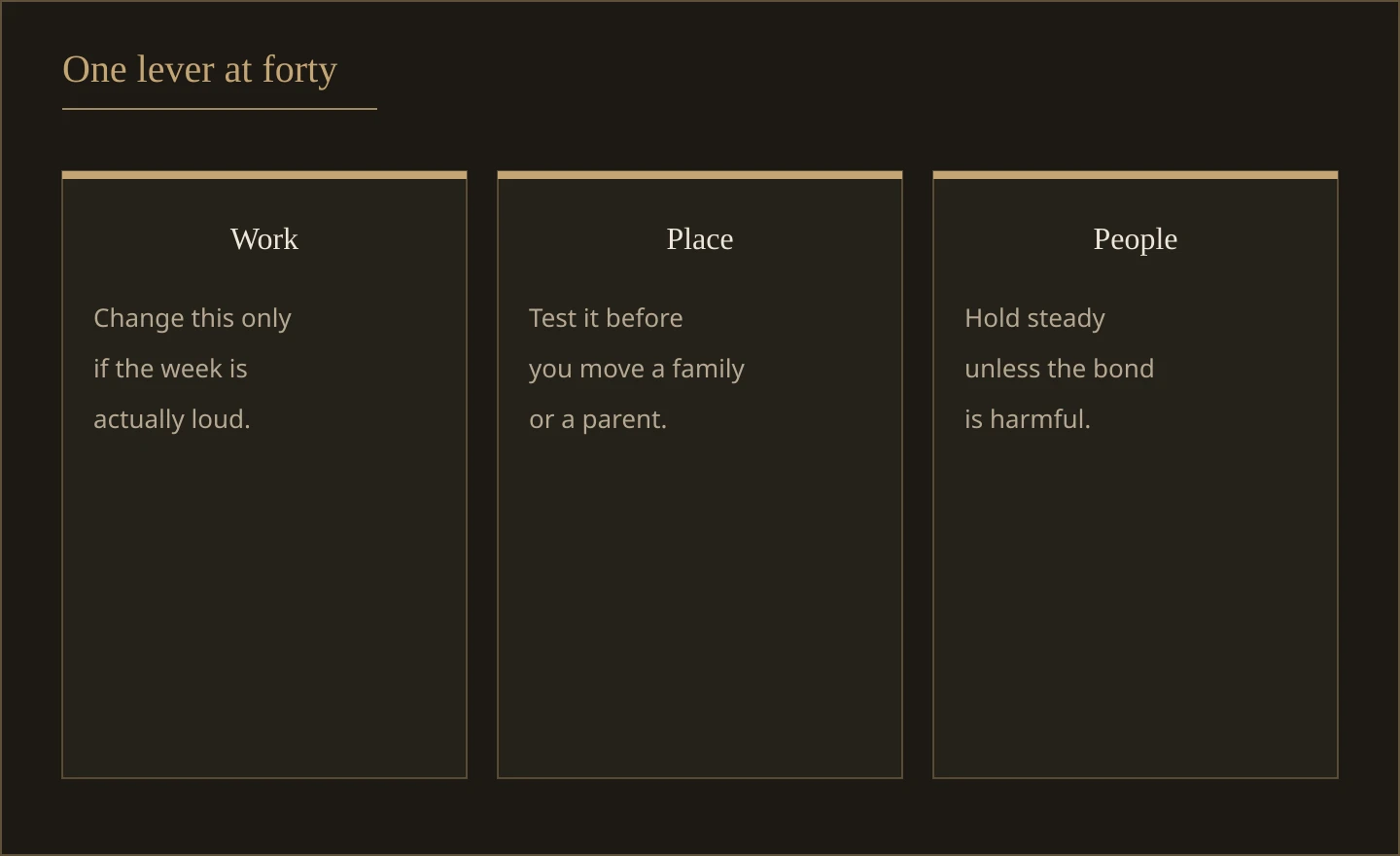
Work, place, and people are still separate, at forty as at thirty. The difference is the weight on each one.
Work. What you do most weeks, and whether the next five years of it are a deliberate bet. This includes staying and changing the brief. A career change at this age is rational when the week-level test and the money both survive contact with your real life. It is a fantasy when it requires you to become a beginner in a field that will not pay beginners who have your obligations. The practical sort is how to pick a career when you are not sure.
Place. Where you sleep, and whether that place supports the work and the people or taxes them. A move at forty moves schools, parents, and a network that took a decade. Test the place before you move the life, when a test is possible.
People. Who you are building the next season with. A partner, children, a parent in your care, friends who know your ordinary week. Do not break a sound relationship to decorate a career experiment. Do not keep a harmful one because the career is the only stable thing in the room. If the same role keeps appearing with a new person, that pattern is older than this birthday. The wider season question is what chapter of life you are in.
Pick the domain that is actually loud. Run a season there. Hold the other two as steady as you can. The younger version of this map, when the checklist itself has just run out, is no direction in life at 30. The later version, when the title itself ends, is finding purpose after the job is over.
What to keep from the first half
A reset throws away information you already paid for. Before you change anything, write three lists.
What you would repeat for five years, even without an audience. Tasks, places, people. If the list is only rest, you are depleted, and direction-talk is premature. Repair sleep, health, and a schedule with an edge before you interpret the emptiness as a calling.
What you would not repeat, even if it keeps paying. Be specific. "Meetings" is not a life. "Being the person who absorbs everyone else's indecision" is often the actual job. If that sentence is yours, it belongs on the list as a task, not as a mood.
What is load-bearing and therefore not available as a mood. A child. A debt. A parent. A health limit. These are walls. A plan that argues with a wall wastes the season.
The pattern under the lists, the part that stayed while the roles changed, is who you are when a pattern repeats. It is evidence. It is not a sentence that has to justify every previous year. You can thank a chapter and decline to repeat it. If the week feels pointless rather than merely unfinished, read how to find meaning in life again.
A season, not a rebirth
Ninety days is long enough to learn and short enough to survive. Name one question the season answers. "Do I want more of this task without the travel?" is a question. "Who am I now that I am forty?" is not a question. It is a spiral with a birthday attached.
At the end you should be able to say a plain sentence. "I am staying in this city, changing the brief, and not making the marriage carry the career." Or "The work is fine, the city is the problem, and I am testing one month elsewhere before I move a family." Or "I was tired, and the lost feeling was the tiredness."
That sentence is what to do with your life at 40. It is not a second youth. Second youth is what people demand when they are unwilling to use the evidence they have. Direction is the next season's bet, chosen on purpose, small enough to correct, and respectful of the life that is already in the room.
If you want that season read as a pattern, not as a mood, a Meridian Reading is a structured written reading of your patterns and direction. It does not tell you to blow up a life that took twenty years to build. The sample reading shows how the document is shaped. Use it beside the season, not instead of it.
See it on the page
Explore the full sample reading in your browser, or begin your own Entry reading when you are ready.
FAQ
Common questions
Should I start over with my life at 40?
Is 40 too late to change what I do with my life?
What if my life at 40 looks fine and still feels wrong?
How is this different from feeling lost at 30?
Continue reading
Related guides
No direction in life at 30, existential crisis
No direction in life at 30, including an existential crisis at 30, usually means the early map ran out. Change one of work, place, or people.
What season of life am I in
What season of life am I in, and how do you start a new chapter in life without quitting, moving, and ending everything in the same week. Name it.
How to pick a career when you are not sure yet
How to pick a career when you are not sure, including a career change after layoff. Test the work in ordinary weeks before you resign into fog.
Finding purpose after retirement, in real weeks
Finding purpose after retirement starts with a schedule, a few people, and one useful task. A grand purpose can wait until the week has a shape.