Learn
Finding purpose after retirement, in real weeks
October 19, 2026
Finding purpose after retirement starts with a schedule, a few people, and one useful task. A grand purpose can wait until the week has a shape.
Finding purpose after retirement is a strange assignment, because the culture congratulates you and then goes quiet. The party ends. The inbox stops. People ask what you will do now, and they want a hobby they can picture. You wanted the job to end, or your body ended it, or the organization did. Wanting the ending does not mean the next morning knows what it is for.
The job was a scaffolding. It set a wake time. It supplied people who expected you. It gave you a status that did not have to be re-explained at dinner. It made some hours matter because someone else was waiting on them. Finding purpose after retirement fails when you try to replace the identity before you replace the scaffolding. A mission statement in an empty week is a poster. The week needs edges first.
Finding purpose after retirement when the title is gone
Grief for a role is allowed even when you chose to leave. You can be glad the meetings stopped and still miss being the person the meetings were for. Those are not a contradiction. Treat the first season as an ending, not only as a start. Endings have a shape: you tell the story a few times, you notice what you do not miss, and you stop performing the title for people who only knew that version of you.
Robert retired from engineering on a Friday in November. By March the garage was organized, the photographs were labeled, and the days were long in a way that felt like a personal failure. He did not need a personal brand. He needed Tuesday to have a place where he was expected, and one problem hard enough that his attention still mattered. The volunteer board he joined out of guilt met monthly and mostly raised money. It did not use him. The community college lab that needed an afternoon of adult supervision did. He is not saving the profession. He is useful for four hours, and the rest of the week has something to orbit.
If you are not retired yet and the question is the decade before this one, what to do with my life at 40 is the earlier fork. If the work is still there and the meaning is thin, start with how to find meaning in the work before you treat retirement as the only exit.
The first months are a structure problem
Give the first ninety days a design that is almost boring.
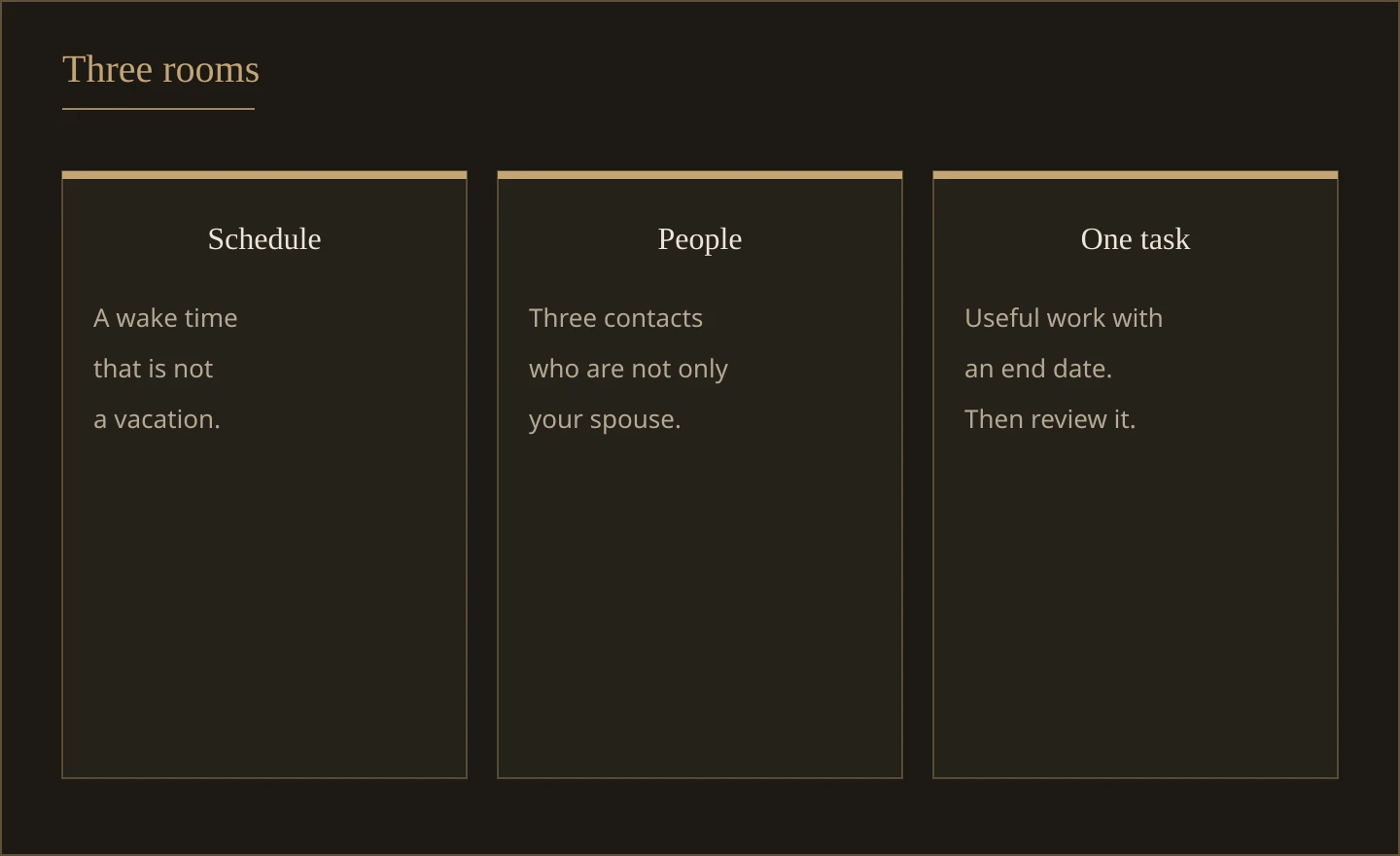
A wake time that is not a vacation. Vacation is a break from a schedule. Retirement is the schedule. Sleeping until the day is half gone feels like freedom for two weeks. Then it feels like disappearance. Pick a morning edge and keep it on days when nobody needs you. The edge is the point.
Three recurring people who are not only your spouse. A standing walk, a class, a meal, a workshop shift. Marriage is not a full social life, and it buckles when it is asked to be one. If you live alone, the three people matter more, not less. Loneliness will imitate a loss of purpose. Company on a cadence is the cheaper test.
One task with an end. A repair, a course you finish, a report someone will use, a shift that would be missed if you did not come. Endless "staying active" is not a task. An end date lets you know whether you want more of the thing.
Money as a plan, not as a mood. Sit with the actual numbers, or with a person whose job is the numbers. Anxiety about running out and a vague sense of being useless get tangled. Separate them. A financial fact has a response. A mood does not, until the fact is on paper.
If you cannot do these because of illness, pain, or a mind that will not hold a schedule, that is medical and practical territory, not a character flaw. Work with your doctors. This page does not give medical advice. The meaning question inside those limits is finding meaning in chronic illness.
What replaces the meeting, not the identity
People hunt for a new identity because the old one was easy to say. "I am an engineer" ended conversations. "I read, I help at the lab, I see my sister on Thursdays" does not sound like a self. It is a life. Let it be smaller than the career. The career was sized to an organization. A person is not an organization.
A few replacements that are real, and the way they go wrong:
Mentoring one person, not "the next generation." One person has a name and a problem. A generation is an audience. If you miss being needed, start with one.
A board or a committee that meets and decides. If the group exists so retirees can feel important, you will know by the third meeting. Leave. Status without a decision is the part of the job you do not have to recreate.
Care you choose. A grandchild, a neighbor, a partner. Chosen care has a boundary. Assumed care, the kind other people assign because you are "free now," becomes resentment. You are allowed to say no to becoming everyone's unpaid extra pair of hands.
A craft with a standard. Wood, a language, a garden that has to survive August, music you practice badly and then less badly. The standard is the purpose. The product can be ordinary. Do not turn the craft into a business in month one unless you already wanted the business. A shop is a job. You just left one.
How to find meaning in life again, after a title stops carrying it, is the same practice at any age: the commitment you still keep once you have named the cost. The season with the title gone is what chapter of life you are in.
A week with three kinds of hours
After the first season, sort your hours into three kinds and look at the ratio.
Hours that maintain you: body, food, the house, the medical appointments you keep. These are not a failure to be purposeful. They are the floor.
Hours you spend with people who know you without the title. If this number is near zero, purpose-talk is premature. You are isolated, and isolation answers every question with "nothing matters."
Hours where your attention meets a standard or a need. This is the slice people mean by purpose. It does not have to be most of the week. It has to be real, repeated, and chosen.
If the third slice is empty, add one block before you add a philosophy. Four hours. A place. A person who would notice if you stopped. Review it in ninety days. Keep it, change it, or drop it based on whether you want the next block, not on whether it impresses your old colleagues.
The pattern under the old title, the part you would keep on purpose, is who you are when a pattern repeats. You do not have to become a different person to have a different week. You have to stop asking the week to feel like the job.
A Meridian Reading is a structured written reading of your patterns and direction. It will not hand you a retirement plan, and it will not replace the Tuesday you still have to build. The sample reading is there if you want to see the document. Use it as context, after the week has an edge.
See it on the page
Explore the full sample reading in your browser, or begin your own Entry reading when you are ready.
FAQ
Common questions
Why do I feel no purpose after retirement?
Does purpose after retirement have to be a big contribution?
What if my partner and I want different retirements?
What if retirement arrives with an illness?
Continue reading
Related guides
What to do with my life at 40, without a reset
What to do with my life at 40: keep two parts of the life steady, change the loud one, and use the evidence of the years you already lived well.
How to find meaning in life again, this season
How to find meaning in life again: name what you still keep, what it costs, and the next commitment small enough to practice in this season.
What season of life am I in
What season of life am I in, and how do you start a new chapter in life without quitting, moving, and ending everything in the same week. Name it.
Burnout career change, and meaning in the work
Burnout career change starts by naming what is thin: craft, usefulness, people, or a standard. Change that slice before you quit the whole job.