Learn
What chapter of life you are in when you feel stuck
October 15, 2026
What chapter of life you are in, including feeling stuck at 30, 40, or 50. A round age often means the old season ended and the schedule did not.
Feeling stuck is often a timing problem before it is a character flaw. The chapter changed. The calendar did not. You are still running the checklist from the previous season: prove you can start, prove you can provide, prove you can be chosen. The checklist is complete, or it failed, and either way it no longer tells you what the next stretch is for.
A chapter is not a birthday rule. It is a cluster of limits and questions that belong together. You can be thirty-four and in a late chapter, or fifty-two and still inside an early one, if the life you lived did not follow the brochure.
What 30, 40, and 50 tend to end
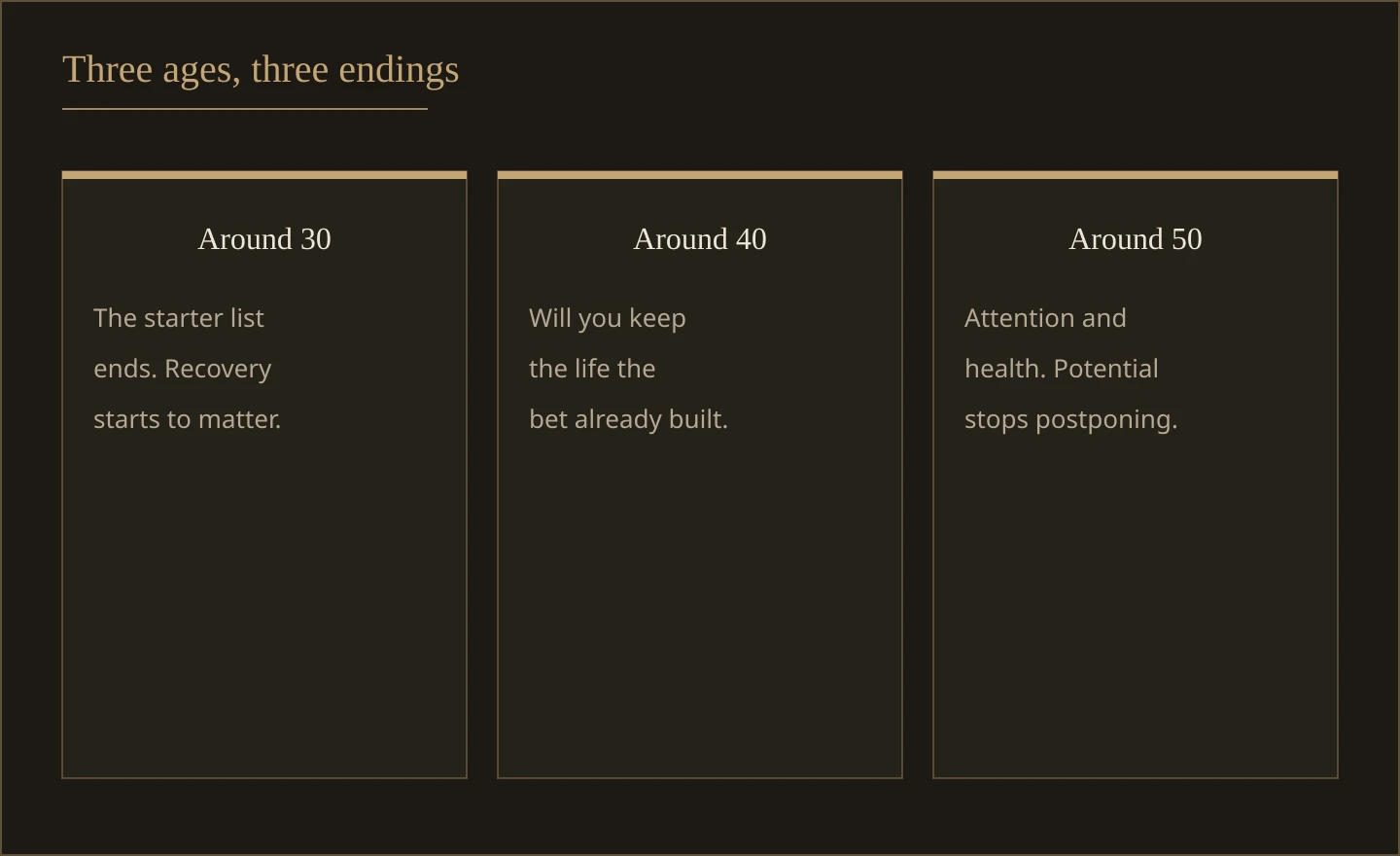
Around thirty, the shared starter list runs out. First job, first city, first proof you can function. Friends become structures you can see. The body stops subsidizing chaos. A narrower version of this, for the early thirties, is feeling lost at 30.
Around forty, the question is less "can I start" and more "is this the life I am willing to keep." A career that was a bet becomes a groove. A relationship is either a household or a delay. People start counting the parents they still have. Stuck at forty is often loyalty to a bet that already paid out, or already failed, and has not been replaced.
Around fifty, the relevant scarcity is attention and health, not potential. Potential was a story that let you postpone. The useful question gets smaller. What do you want the next decade of Tuesdays to contain. Who needs you in a way you accept. What work is still worth the recovery it costs.
These are tendencies, not sentences handed down by a birthday. The month after the birthday is usually more honest than the month of it.
How to read the chapter you are actually in
Ask what recently became expensive that used to be free: recovery, patience, the benefit of the doubt from strangers. That expense is the edge of the chapter.
Ask which question you are still answering that the life has already answered. If you have the job, the house, or the proof, and you are still organized around getting it, you are living in the previous chapter's homework.
Ask what you would protect if you were not allowed to change work, place, and people in the same season. The answer is a clue. The blow-up is usually an attempt to feel the chapter change in one weekend. If you are at that crossroads, read which path to choose and change one variable.
Then give the chapter one question a ninety-day season can answer. "Do I want more of this task" is a question. "Who am I, finally" is a spiral. That spiral has its own page: who you are when a pattern repeats. If the chapter feels pointless rather than unfinished, start with the meaning of your life, and how to find purpose.
A document for the season, not a forecast
Meridian Reading includes a chronology and a forward arc inside a 22-section life path reading. It is reviewed individually and delivered within 48 hours, for $197 once. Lines are labeled Full, Clear, or Working. It describes the pattern and the season. It does not forecast your next move.
Read the sample. Keep the sentences you can match to the season you are actually in. The chapter still has to be lived.
See it on the page
Explore the full sample reading in your browser, or begin your own Entry reading when you are ready.
FAQ
Common questions
What chapter of life am I in?
Why do I feel stuck at 30, 40, or 50?
Is a round birthday a deadline for a big change?
Does a life path reading predict the next chapter?
Related
The meaning of your life, and how to find purpose
What the meaning of your life is, and how to find purpose: name what you keep, what it costs, and the next commitment small enough to practice.
Relationship patterns: the same story, new people
Why the same partner patterns repeat, and how to understand parents without a verdict. Separate what you inherited from the role you still rehearse.
Which path to choose when the next step splits
Should you quit, move, or change the work? Separate those decisions and test one. A life path reading is context for the choice, not the choice itself.