Learn
Finding meaning in chronic illness, with care
October 19, 2026
Finding meaning in chronic illness means fitting a life to the body you have, working with your doctors, and refusing the idea that pain is a lesson.
Finding meaning in chronic illness is a hard sentence to be handed, usually by someone who is not living in your body. They want the pain to have a point, because a point is easier to stand next to than an illness that simply continues. You do not have to produce that point for them.
The illness is a fact about your body and your days. Meaning is a separate question: what you will protect, love, and take responsibility for inside the limits you actually have. Finding meaning in chronic illness does not mean liking the illness, trusting it, or calling it a teacher. It does not mean you are failing if some weeks the only honest sentence is that this is awful.
This page is not medical advice. It cannot tell you what is wrong, what to take, what to eat, or whether a treatment is right for you. Those questions belong to the doctors and other licensed clinicians who know your case. Bring the medical questions to them. What follows is about the life around the appointments.
Finding meaning in chronic illness when the old pace is gone
The old pace was a kind of identity. You answered messages at a certain speed. You worked a certain number of hours. You were the reliable one, the fit one, the person who did not cancel. Chronic illness takes that pace, partly or wholly, and other people experience your limit as a change in personality. It is not. It is a change in capacity.
Grief for the old pace is appropriate. You can miss the person who said yes without a calculation. Anger is not a lack of acceptance. Acceptance, if it comes, is a clearer view of what this week can hold, updated when the body updates.
A useful inventory is boring and kind.
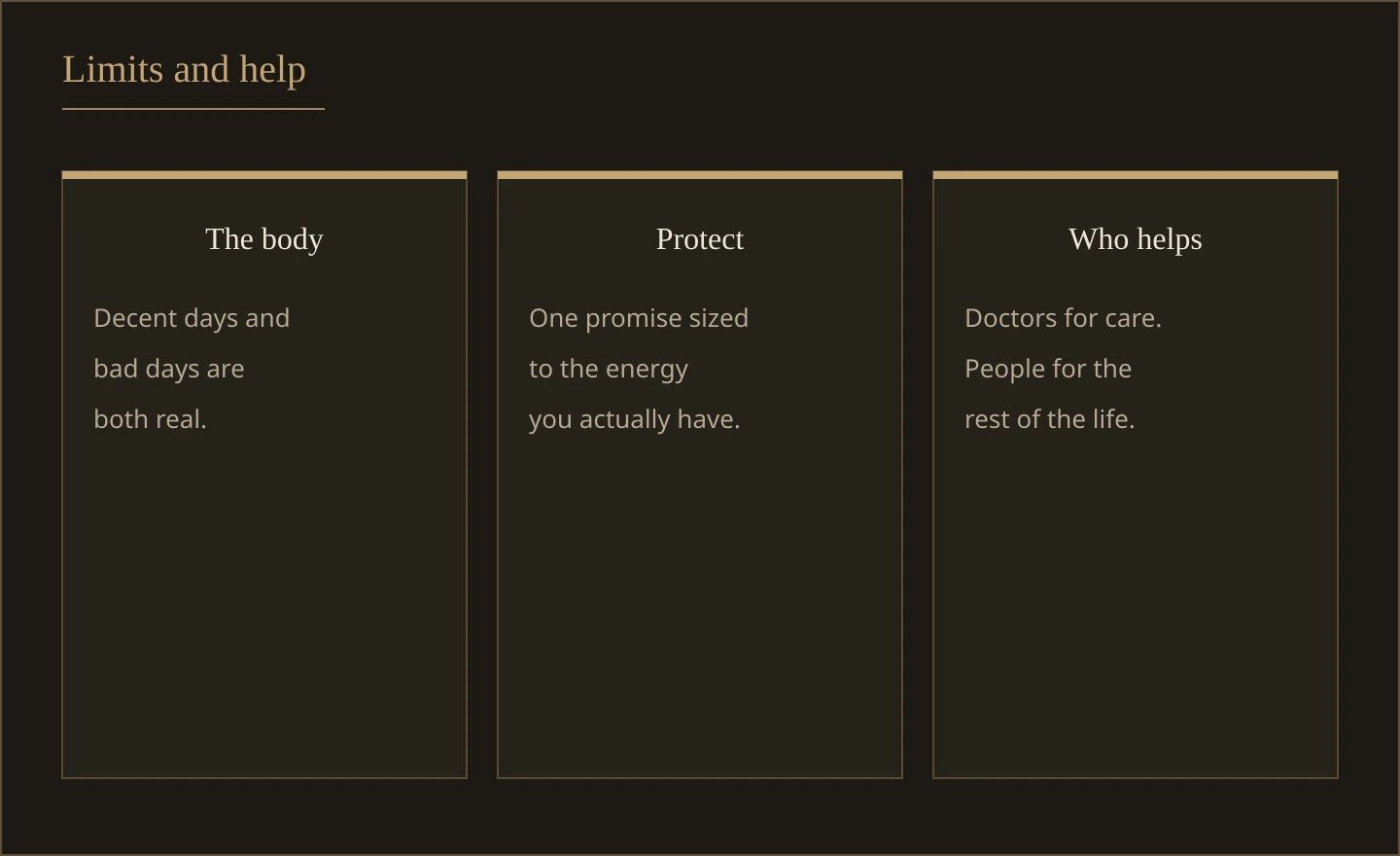
What the body can do on a decent day, and what it can do on a bad one. Write both. Plans that only work on decent days will punish you.
What is maintenance and therefore not optional: medication your clinician prescribed, the appointments, the rest they told you matters, food and sleep in whatever form your care team has already discussed with you. Do not take new regimens from a stranger's essay. This is not that essay.
What you are still willing to spend scarce energy on. A person. A piece of work. A standard. If everything is priority, the illness will choose for you, badly, by crash.
Malik was a project manager who closed every loop. After a chronic condition made full days unpredictable, he kept trying to be that person and then disappearing for a week. The version that fits is narrower: two colleagues can count on him for a defined kind of work, with a backup when he cannot. That promise is one he can keep. The old one was injuring him.
Chronic illness and the question why me
Chronic illness and why me is one of the oldest questions a person asks. It deserves a straight answer.
You are not being punished. Good people get ill. Careless people stay well. The distribution is not a moral report card. If your tradition comforts you, use that, and ignore anyone who uses it to blame you. A non-religious account is also enough: this happened, you did not earn it, and there may be no satisfying why.
There can be a medical why. Ask your doctors, and write the questions down before the appointment. If they do not know yet, that is a medical statement. It is not a personal failing, and it is not an invitation to invent a spiritual one.
Why me becomes harmful when it turns into a second job. You rehearse every past choice, looking for the one that led here, then sentence yourself. Stop the trial. You are allowed to follow the care plan your clinicians gave you without also prosecuting your past. The wider question of living with an event you did not schedule is in why this happened, and what is still yours. That page will not explain your labs. It will refuse the idea that you had to deserve the event.
Finding purpose in life after a medical ailment
Finding purpose in life after a medical ailment is the moment the ailment stops being a disruption and becomes the condition of the next chapter. The hospital chapter had a plot. The long chapter does not. A slogan is easy. A Wednesday is not.
Try three questions, and answer them for this season only.
What will I stop pretending I can still do? The pretense is expensive. It spends the energy the real commitments needed. Dropping a role, a hobby, or a standard of availability can be grief and relief in the same week.
What will I protect even when the day is small? One relationship handled honestly. One kind of work, reduced. One practice of care for your body that your clinicians already support. Protection is purpose. It does not have to be visible on the internet.
Who can stand the unedited version? You need at least one person who does not require you to be inspiring. If everyone in your life needs the recovery story, you will lie to keep them. A counsellor used to illness, or a patient community your clinic recognizes, can be that company when friends cannot.
The season you are in now may not match the age on your birthday. What chapter of life you are in is a way to separate the calendar from the actual chapter. If the loss beside the illness is a child you will not have, or a life you planned that included one, purpose in a life without children is the closer grief. If the question is what any of the remaining commitments are for, how to find meaning in life again asks that without asking you to be well first.
Meaning that fits the body you have now
Meaning that ignores the body becomes another way to get hurt. A few practices are sturdy. None of them is a treatment.
Pace on purpose. If a crash follows a certain kind of day, stop before the crash. Tell people the limit in advance. A limit said early is a plan. A limit said from bed becomes an apology you should not have to keep making.
Keep a standard that is not speed. Quality, honesty, care for a particular person, a craft you can do in short sessions. People who loved you for your speed may need the truth. Their disappointment is not yours to erase.
Let identity be wider than the patient role, and wider than the denial of it. You are not only a diagnosis, and you do not have to treat the diagnosis as a side note so other people can relax. A plain sentence is enough: this is part of my life, and it is not the whole of it.
Contribute at the size of real energy. A small, kept commitment is still a commitment. A huge one chosen to prove you are unchanged will collapse. That collapse is a sizing error, not a verdict on your worth.
Review the season. What fit in March may not fit in October. Put a date on the calendar to ask whether the commitments still fit the body, and change them without calling yourself inconsistent.
Work with your doctors, and get company for the rest
Stay in care. Ask questions. Bring a list. If a clinician dismisses your symptoms, you are allowed to seek another clinician. That is navigation of the system, not a treatment recommendation from this page. Do not stop a prescribed care plan because an essay, a video, or a friend offered a cleaner story. Talk to the person licensed to change the plan.
Get company for the part medicine does not cover. A licensed counsellor or therapist can help with the grief, the fear, and the identity shift. A support community for your specific condition, ideally one your clinic or a national patient organization recognizes, can cut the loneliness of explaining. Leave any group that sells a cure, blames you for being ill, or treats your pain as content.
If the meaning question has become a safety question, if you are thinking of hurting yourself, contact local emergency services now. In the United States, call or text 988, the Suicide and Crisis Lifeline. A life with illness is still a life other people can help you stay inside. You do not have to decide, alone, on a bad night, what the illness means.
You can have a purpose and still wish you were well. Those are not competing achievements. Wish for ease. Keep one commitment that fits. Let the doctors do the medicine. Let the people who can stand the truth stay close. That is a way to live. It is not a silver lining, and you never had to earn it.
FAQ
Common questions
Why me? I have a chronic illness and I did not deserve it.
How do people go about finding meaning in chronic illness?
How do I start finding purpose in life after a medical ailment?
What if people say the illness happened for a reason?
Continue reading
Related guides
Why did this happen to me: making sense of it
How to make sense of a loss, a breakup, or a layoff without self-blame. A written reflection is not therapy or crisis support. In the US, call or text 988.
How to find purpose in life without kids, in practice
How to find purpose in life without kids, including when you are childless not by choice. Grief is allowed. Purpose is not a replacement child.
How to find meaning in life again, this season
How to find meaning in life again: name what you still keep, what it costs, and the next commitment small enough to practice in this season.
What season of life am I in
What season of life am I in, and how do you start a new chapter in life without quitting, moving, and ending everything in the same week. Name it.