Learn
AI makes me feel useless: meaning after the work
October 19, 2026
AI makes me feel useless is a worth question, not a verdict. Separate the task a tool cheapened from the person who still has a week to live.
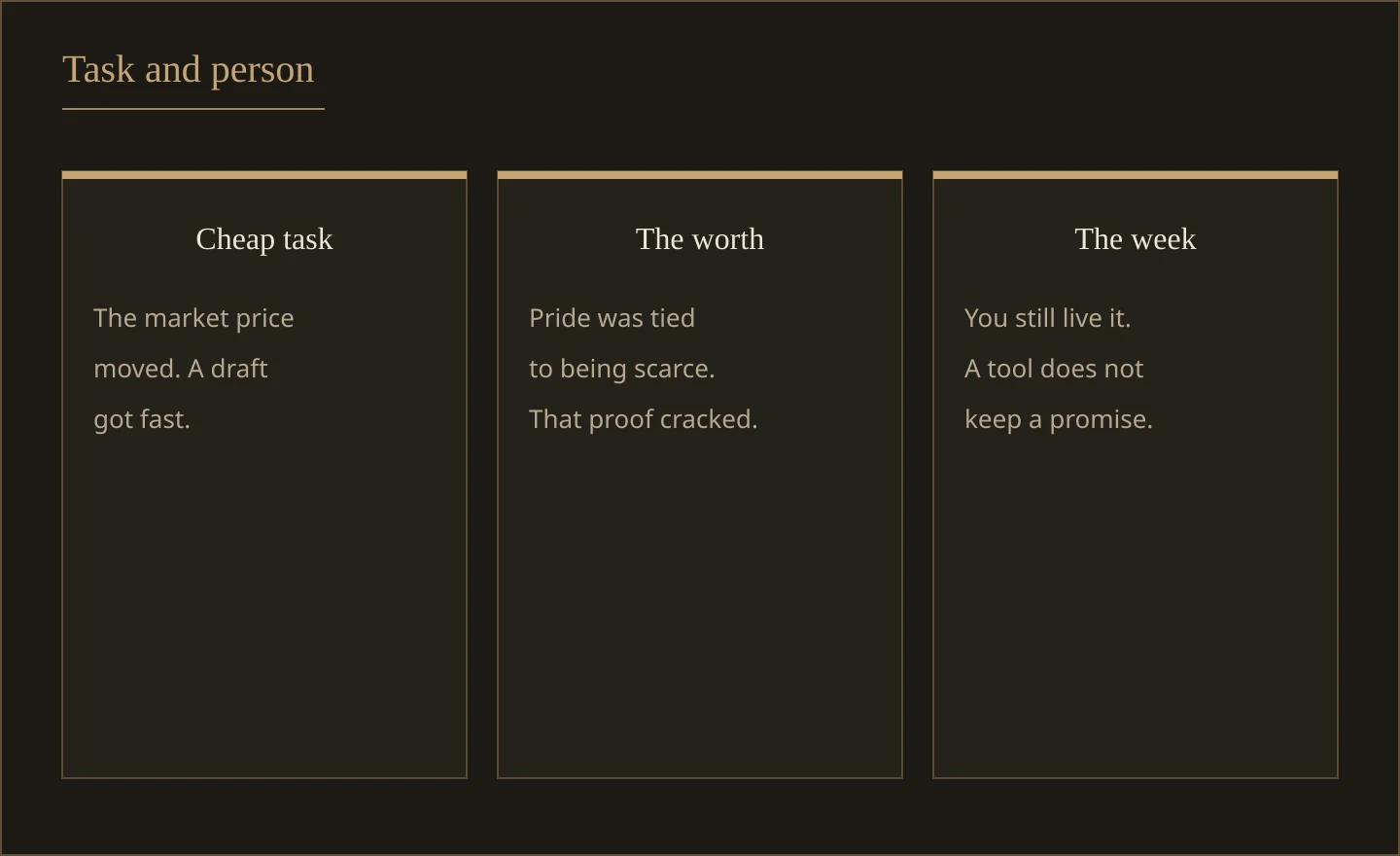
AI makes me feel useless is a sentence people say quietly, often before anyone takes their job. They watch a tool produce, in a minute, the paragraph, the sketch, the first draft of the code, the summary they were proud to do carefully. The pride was not only vanity. It was evidence. When the evidence gets cheap, the conclusion arrives fast: if the task is cheap, I am cheap.
That conclusion skips a step. A price is what a buyer will pay for a task under the tools of this year. It is not a measurement of whether your attention, your care, or your particular life is worth having. The skip is understandable. A culture that paid you for output trained you to treat output as a self.
AI makes me feel useless, and what the feeling is pointing at
Name the task. Not "my work." The actual unit. The status email. The first layout. The literature scan. The bug that is a known shape. The lesson plan from a template. Specificity keeps the feeling from annexing the whole person.
Then say the two facts separately.
The task is less scarce. That can be true.
You are not a task. That is also true, and it does not pay the rent by itself.
People who collapse the two facts start performing despair or performing indifference. Both are expensive. Despair stops the inventory. Indifference stops the care that was the real skill inside the task. You can admit the market moved and still refuse the verdict.
Lena edits research summaries for a policy office. A tool now drafts a summary she used to spend a morning on. Her colleagues treat this as a gift. She feels erased. The useful distinction for Lena is between the draft and the judgment: which number is load-bearing, which source is advocating, which sentence will be quoted out of context by someone with a motive. The draft did not take that. Her office may still fail to pay her for it. Those are different problems. One is a feeling about worth. One is a negotiation about the job. Do not solve the negotiation by agreeing that you have no worth, and do not solve the feeling by pretending the negotiation is fine.
If the job itself is gone, the practical sequence is what to do if the tool takes the role. If the job remains and the week is flat, the closer page is how to find meaning in the work.
An AI existential crisis is about worth, not only work
An AI existential crisis sounds like a technology problem and behaves like an old human one. The dread says: if this can be done without me, then the reason I gave my days has been revoked. People feel it at twenty-five and at fifty-five. The younger version fears they missed the era when effort counted. The older version fears the era took the proof back.
Both versions deserve a plain answer. Effort still counts inside a life. It counts less, in some tasks, as a way to be scarce. Scarcity was always a shaky foundation for a self. Another person, a cheaper city, or a younger hire could undercut you before a model could. The tool makes the undercutting obvious and fast. Obvious is not the same as total.
Watch what you do in the evening after a demo. Demos are built to produce this feeling. They show the clean case. They do not show the repair, the context, or the consequence. If your nights are a sequence of demonstrations of your own replaceability, you are training the crisis. Limit that input the way you would limit any other input that leaves you worse at your actual life. Then put one hour into a commitment the tool cannot keep for you. A person who needs you by name. A body you maintain. A local obligation that does not care how fast a paragraph can be generated.
If the dread includes wanting to hurt yourself, that is no longer a question about work. Contact a licensed professional or local emergency services. In the United States, call or text 988. A page can wait.
What is my purpose if AI can do my work
What is my purpose if AI can do my work depends on what you were using the work to prove.
If the purpose was "I make things other people cannot make," update it. Other people, and now tools, can make a passable version of many things. A purpose that requires permanent scarcity will keep breaking every time a tool improves. You will spend your life chasing the next task that has not been automated yet, and you will call the chase meaning.
A sturdier purpose is visible without a scarcity claim.
A specific person. Not humanity. A child, a parent, a partner, a student, a client whose situation you actually know. Tools do not sit with a particular person and bear the consequence of being wrong about them.
A standard. You still know the difference between a draft that is acceptable and a draft that will do harm, even when both look fluent. Keeping the standard when nobody is grading it is a purpose. It is quieter than a mission statement.
Responsibility you accept by name. Someone has to decide, ship, refuse, or repair. The tool does not attend the meeting where the decision is owned. If your name is on the outcome, you are not decorative.
Taste and care inside a field. Not taste as a pose. The accumulated sense of what matters in a domain you have actually practiced. That sense is slow. It is also the part a prompt imitates and does not have.
How to find meaning in life again, when a previous proof has gone cheap, is the same practice without the technology in the title: name the commitment you still keep after you have named the cost. The part of you that stays when the role changes is who you are when a pattern repeats. The season this dread arrived in is what chapter of life you are in.
A practice for the week the tool got better
Once this week, write the task that got cheap in one line. Under it, write what you were using it to prove. Under that, write one commitment that does not depend on the task staying scarce. If you cannot name the commitment, you are not failing a philosophy exam. You are empty, tired, or out of practice at choosing. Rest and a smaller social load come before a new vow. Exhaustion imitates a missing purpose, and a tool demo is an efficient way to feel exhausted.
Do not require the next month to restore the old feeling of being impressive. Impressive was a side effect of scarcity. Useful, responsible, and particular are available on an ordinary Tuesday. They are less cinematic. They are also harder for a product announcement to take away.
If you want those questions looked at as a pattern, rather than as a reaction to the latest demo, a Meridian Reading is a structured written reading of your patterns and direction. It will not rank tools or tell you that your field is safe. The sample reading is the document itself. Use it as a mirror for the week you still have to live.
See it on the page
Explore the full sample reading in your browser, or begin your own Entry reading when you are ready.
FAQ
Common questions
Why does AI make me feel useless even though I still have a job?
What is an AI existential crisis?
What is my purpose if AI can do my work?
What if the AI existential crisis feels like despair?
Continue reading
Related guides
What to do if AI takes your job, and what next
What to do if AI takes your job: separate pay from identity, test one skill someone will still pay for, and skip a random new credential now.
How to find meaning in life again, this season
How to find meaning in life again: name what you still keep, what it costs, and the next commitment small enough to practice in this season.
Burnout career change, and meaning in the work
Burnout career change starts by naming what is thin: craft, usefulness, people, or a standard. Change that slice before you quit the whole job.
How to find out who you really are
How to find out who you really are: the pattern that stays when the role changes, seen in scenes rather than labels, and kept only if you would choose it.