Learn
Why did this happen to me: making sense of it
October 15, 2026
How to make sense of a loss, a breakup, or a layoff without self-blame. A written reflection is not therapy or crisis support. In the US, call or text 988.
A loss, a breakup, or a layoff removes a structure that was explaining the days. People ask why it happened to them because random feels cruel, and a moral would make the pain feel placed. You do not have to earn an explanation in order to grieve.
Meridian Reading is not therapy, and it is not crisis support
Meridian Reading is a structured written reflection. It is not therapy. It is not crisis support. It will not sit with you through the night, and it is not a person who can keep you safe.
If you are in danger, or you are thinking of hurting yourself, contact a licensed professional or local emergency services now. In the United States, call or text 988, the Suicide and Crisis Lifeline. Outside the United States, use the emergency number or a crisis line where you live. A document can wait. Your safety cannot.
Three events, one question
A death, a breakup, and a layoff are not the same event. They share a question because each one takes away a reason the week made sense. The job was why you got up. The relationship was why the apartment made sense. The person who died was a witness to a version of you that nobody else holds.
You can be angry without inventing a villain so the anger has a tidy address. You can notice that some of the pain is the loss itself, and some of it is the future you had already spent in your head. Both are real. Neither one is proof that you deserved the ending.
Making sense without blaming yourself
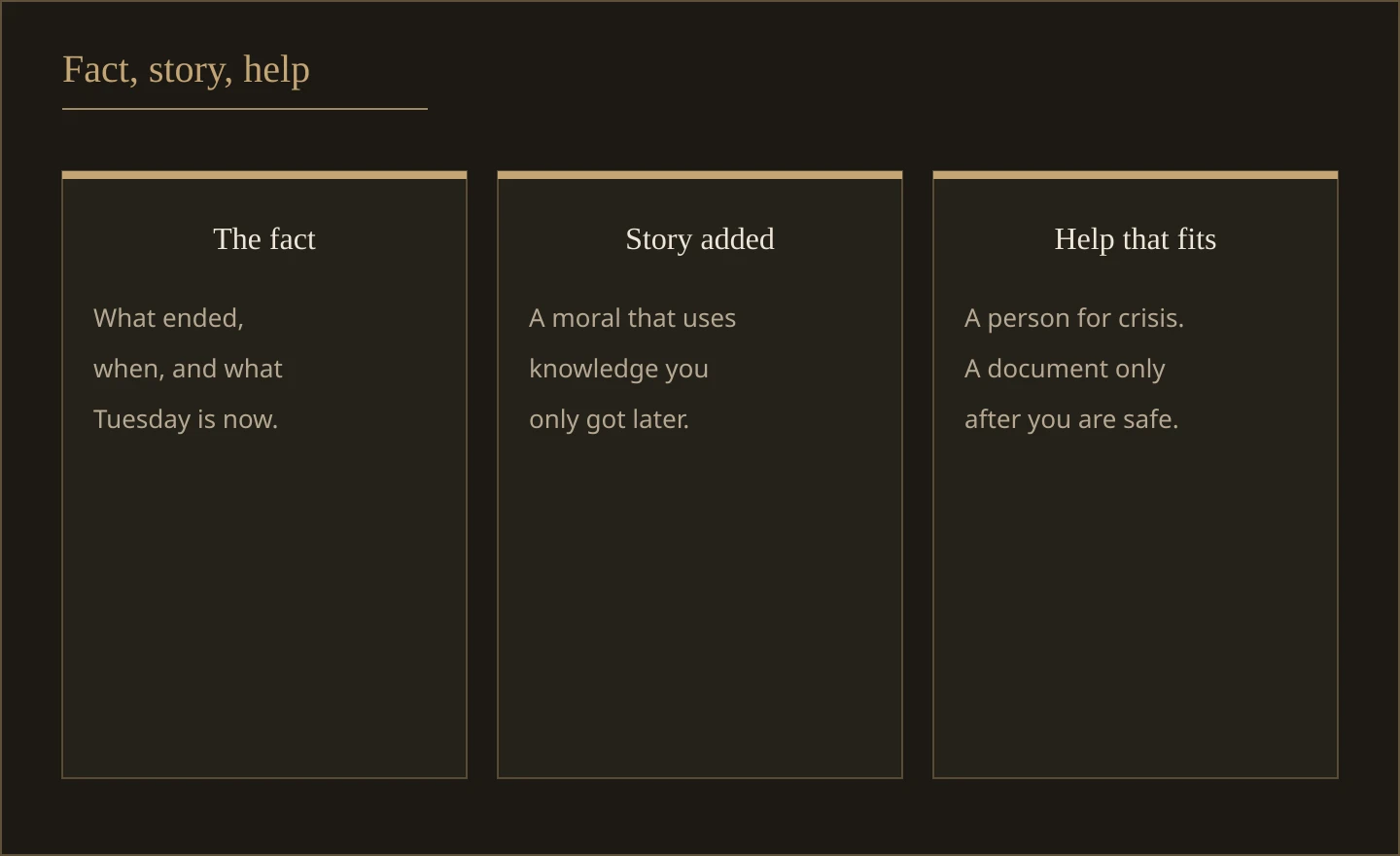
A useful account has three parts.
The fact. What ended, when, and what is now true on a Tuesday. "I was laid off on a Thursday" is a fact. "I am the kind of person this happens to" is a story.
The story you are adding. Write it in one sentence. Then ask whether you had that information before the ending, or only after. Many aftermath stories use knowledge that arrived later. That is hindsight dressed up as a character flaw.
The part that is yours now. Not why it happened. What you will protect in the next season, and what you will not rebuild out of panic. A rebound job, a rebound relationship, and a rebound city try to end the question quickly. They often restart it.
What not to decide in the first weeks
Do not make the permanent decision while the shock is still doing the talking. Leave harm. That is a different category from restlessness. Do not resign from the rest of your life in the same week you bury a person, a marriage, or a job.
Do tell one person who can stand the unedited version. Do keep sleep, food, and a walk on a schedule. Do let a practical list exist beside the grief. Bills do not pause because the question is large. Handling a bill is not a betrayal of what you lost.
If another person harmed you, sense-making is not reconciliation, and it is not your job to make their behavior reasonable. If you need protection, a doctor, or legal advice, get those from people licensed to give them. This page is not that help.
Where a document helps later
When you are safe, and the acute crisis has passed, a different question can be honest. Do I choose the same kind of absence. Do I stay until the room goes cold. Do I build a life that only works if I never stop. Those questions are about repetition. They are not a theory of why you deserved the loss.
If the same relational role keeps returning, read relationship patterns. If you are asking which season this is, read what chapter of life you are in. If the ground under you is direction more than grief, feeling lost at 30 is a narrower map. If the question has become what the next commitment is for, read the meaning of your life, and how to find purpose.
Meridian Reading can hold that later question as a 22-section life path reading, reviewed individually, delivered within 48 hours, for $197 once. See the sample reading. It is a structured written reflection. It is not a counselor, and it is not a reason the hard thing happened.
See it on the page
Explore the full sample reading in your browser, or begin your own Entry reading when you are ready.
FAQ
Common questions
Why did this happen to me?
Is Meridian Reading therapy or crisis support?
Should I make a big life decision right after a loss?
When is a written reflection the wrong kind of help?
Related
The meaning of your life, and how to find purpose
What the meaning of your life is, and how to find purpose: name what you keep, what it costs, and the next commitment small enough to practice.
Relationship patterns: the same story, new people
Why the same partner patterns repeat, and how to understand parents without a verdict. Separate what you inherited from the role you still rehearse.
What chapter of life you are in when you feel stuck
What chapter of life you are in, including feeling stuck at 30, 40, or 50. A round age often means the old season ended and the schedule did not.