Learn
How to pick a career
October 19, 2026
How to pick a career from options you can name: constraints, the work itself, and an on-ramp you can test, distinct from the guide for when you feel stuck.
How to pick a career is a choosing problem. It assumes you can name options, or that you can name them after one honest pass over work you have already done. If you feel stuck and you cannot tell the field from the seat, that is a different page: how to pick a career when you are not sure yet. That guide sorts skill against energy and tells a field problem from a role problem. This one is the sequence you use once the options exist.
How to pick a career
Career offices already publish this order. Follow it, then use the filters inside the steps so a long list does not pretend to be a decision.
The Yale Office of Career Strategy describes five steps: self assessment of interests, values, skills, and personality; identify and research options; evaluate and prioritize; try the option; then reflect. Yale is explicit that an assessment cannot define you or tell you what to do. It only suggests where to look next.
CareerOneStop, from the U.S. Department of Labor, offers an Interest Assessment, a Skills Matcher, and a Work Values Matcher. It notes that one result can point at hundreds of occupations, including ones that do not interest you, and that more than one assessment is how you widen the list before you decide. People who have seen you work belong in that conversation. The assessment does not pick.
- Name the decision. Three decisions hide under "career." A first real path, when you have skills and no stake in a field yet. A change, when you already have a stake and you are deciding whether to spend it somewhere else. A lane, when the field is fine and you are choosing a posture inside it: maker, seller, fixer, teacher, manager, founder. Write which one is yours before you score anything. People who skip this compare a first job with a reinvention and call the confusion openness. If quit, move, and a new field are tangled together, separate them in which path to choose when the next step splits.
- Build a short list from evidence. Options come from tasks, not from a poster of respectable lives. Write work you have already been trusted with, including the unglamorous parts. Write what a person who has seen you work would hire again. Write one adjacent step from each, the job that uses the same difficulty in a new room. If that list is empty, take an interest, skills, or values assessment and keep only the occupations you can describe. Add at most one option that is not adjacent, if it has survived your attention for more than a mood. A list of eight is a way to avoid picking. Hold two or three.
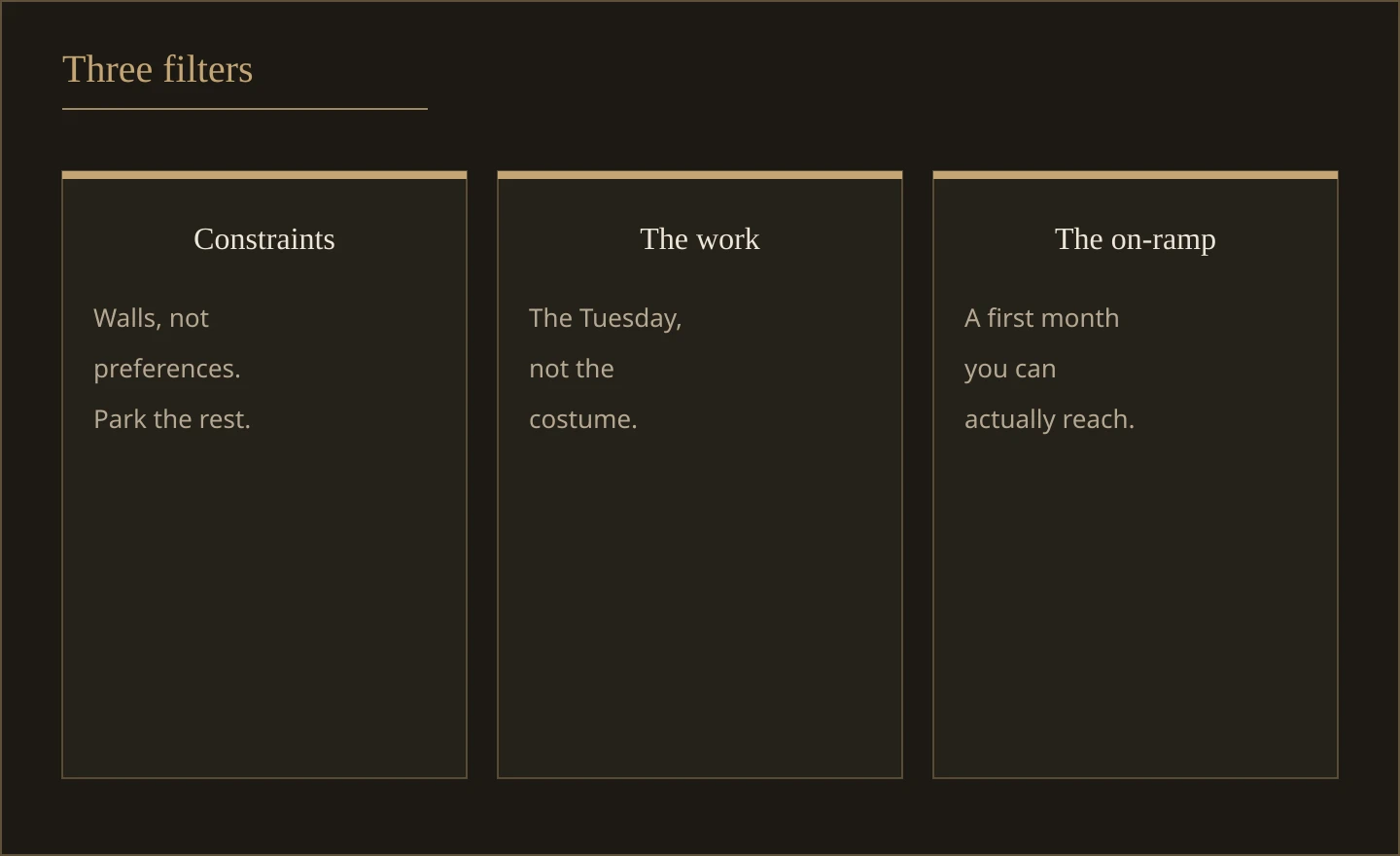
- Research the ordinary work. On an ordinary Tuesday, what do you actually do for most of the hours? Read what people in the field read. Ask someone who does the unglamorous version. If you cannot describe that Tuesday, you are choosing a costume. Yale's research step is this, not a tour of job titles.
- Delete what breaks a wall. A wall is money on a timeline you can survive, caregiving, a place, a body, a visa, or a license you are not willing to spend years on. A wall is not a vibe. If the option fails, park it. Parking is a decision. Pretending is not.
- Prefer the work and the on-ramp. Prefer the option whose Tuesday uses work you respect, not work you plan to escape from inside the job. Then ask how you reach the first real month: a portfolio piece, a bridge role, a conversation, a class, a license. An option with no on-ramp is a wish. Prefer the option you can touch in the next season without burning the structure that pays for the experiment. That trial is Yale's action step: a real slice of the work, not a new identity announced in advance.
- Pick for a season, or park on purpose, then look back. If one option survives, pick it for a defined season and write the stop condition in observable language. "I still dread the core task after I have practiced it" is observable. "I feel unfulfilled" is not, until you can point at the hour that produces it. If two survive, pick the one that is easier to reverse. A new seat in a field you know is easier to undo than a long credential. If none survive, you do not have a picking problem. You have a constraint problem or a fantasy list. Fix the list. Do not quit in order to feel decisive. After the trial, write what was enjoyable, what was not, and whether it was the work or the people. That is the reflection step. A pick that skips it is a costume with a start date.
The season matters. A pick made to escape a chapter often recreates the chapter in a new office. What chapter of life you are in is the check for that. If the career words are standing in for a self, read who you are when a pattern repeats. If you do not yet know what you want, only which jobs sound impressive, go back to how to find what you want to do in life. If you are choosing a major rather than a job, use what you should study while you are still undecided.
Where a reading fits, and where it does not
A Meridian Reading does not hand you a title. It can show the pattern under the options and the season you are choosing inside. That is useful before you pay for a long credential or hire someone to optimize a search. It is useless as a substitute for the Tuesday description. If you cannot describe the work, no document should be allowed to choose it for you.
The sample reading is there if you want to see the object. The filter above does not require it.
See it on the page
Explore the full sample reading in your browser, or begin your own Entry reading when you are ready.
FAQ
Common questions
Is Meridian Reading an astrology reading?
What if I do not have options yet?
Should I take a career test before I pick?
Will a reading choose my career?
Continue reading
Related guides
How to pick a career when you are not sure yet
How to pick a career when you are not sure, including a career change after layoff. Test the work in ordinary weeks before you resign into fog.
How to decide between two jobs or career paths
How to decide between two jobs by separating the seat, the field, and the life around them, then testing one path while the rest of life stays put.
What should I study if you are still undecided
What should I study when you are undecided: sample the ordinary Tuesday of a field, respect money and time, and treat the major as a bet you can revise.
How to find what you want to do in life
How to find what you want to do in life: separate desire, cost, and a trial you can run now, then cross-check the guides for purpose, study, and work.