Learn
How to find what you want to do in life
October 19, 2026
How to find what you want to do in life: separate desire, cost, and a trial you can run now, then cross-check the guides for purpose, study, and work.
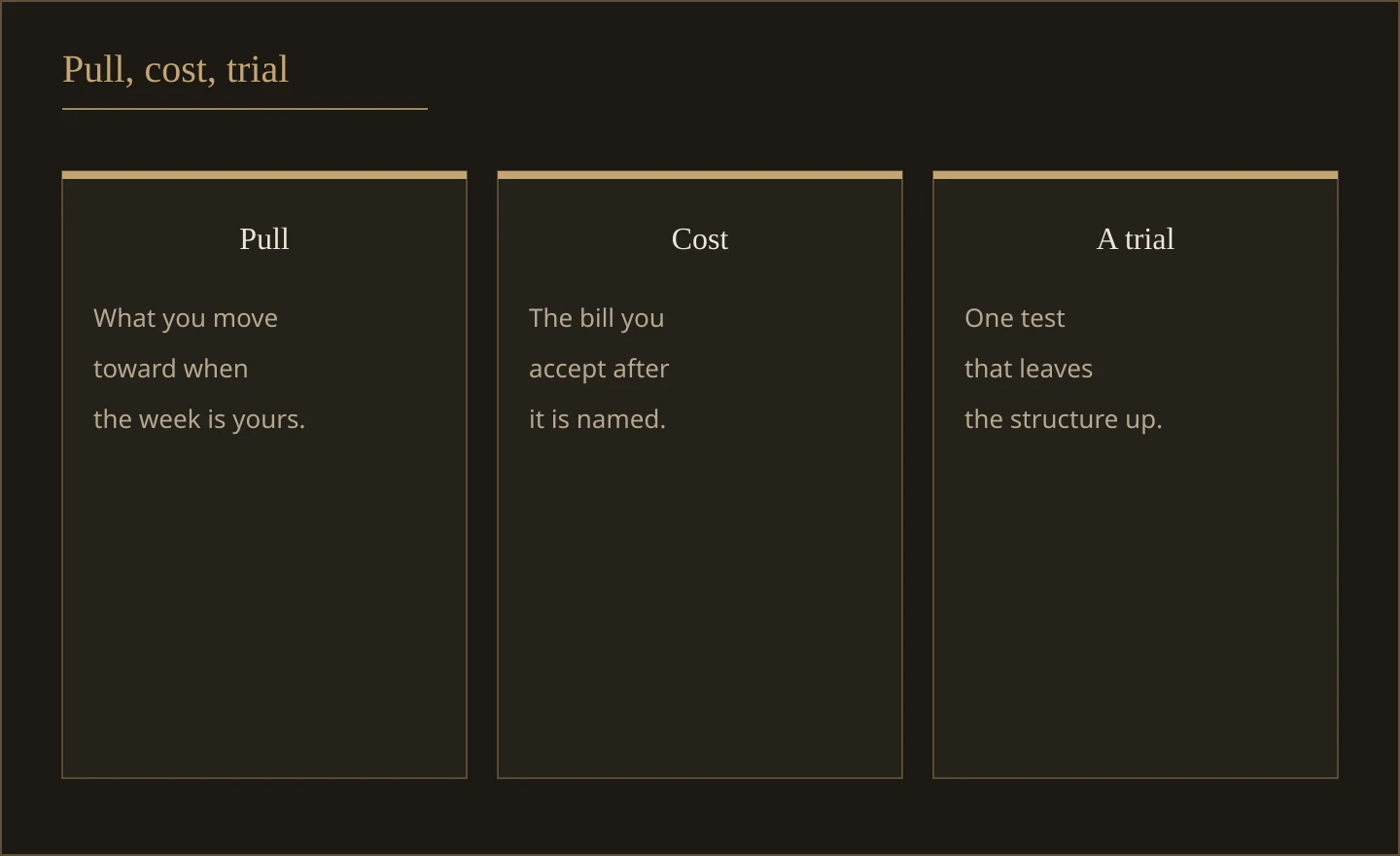
How to find what you want to do in life gets asked as if the answer were hidden somewhere behind you. Most of the time three different questions are wearing one coat. What pulls you. What you are willing to pay. What you can try while the rest of the structure still holds. Until you separate them, every option feels both obvious and impossible.
This is not the quiz page. If you want the case against a purpose quiz, and a fourteen-day look at the tasks already in your week, read how to find what you want to do in life, in the longer version. Stay here if you cannot yet tell desire from a costume you are supposed to want.
How to find what you want to do in life
Two public guides are useful because they refuse a single revelation.
80,000 Hours says to rank a few guesses even while you are unsure, write the uncertainties that would change that ranking, then investigate them with cheap tests: a few hours of reading, conversations with people who do the work, a short project, and only then a longer commitment. Update the ranking when the test changes it. Their page is about work you can do well. Borrow the sequence. Leave the rest of their framework on their site.
The UCSF Office of Career and Professional Development teaches the same shape to PhDs and postdocs, as a loop you repeat: self assessment, exploration through research and real tasks, reflection, preparation, and a job search you often run while the earlier steps are still open. Ruling a path out counts as progress.
- Write the pull. Work, people, and problems you move toward when the week is yours. Include the slight ones. A subject you read when you are supposed to be doing something else. A task you volunteer for. A conversation you leave more awake. Titles and identities do not go on the page. Scenes do.
- Write the drain and the walls. Drain is tasks you can already do that you still resent. Skill without appetite is information. Appetite without any skill belongs on the pull list. Resentment before you have the skill is often just the cost of learning. Resentment after the skill is the bill. Walls are money, caregiving, a place you refuse to leave, a body, a visa, a debt. These are not preferences. An option that requires you to pretend a wall is gone is not an option this season. What you want, in a form you can live, is a pull you still accept after the cost is written next to it, inside the walls. A pull with no cost is a mood. A cost with no pull is a duty. Duties are real. They are not a vocation just because they are heavy.
- Rank one or two guesses. Not six. A long list is a way to avoid the next step. The rank can be rough. Waiting for certainty before you rank is how the question stays decorative.
- Name the uncertainty that would change the rank. Usually it is the ordinary day, not the title. What do the hours actually contain. Who already does the unglamorous version. Which cost you have not written down. If you cannot name an uncertainty, you are collecting moods.
- Run one cheap test inside the life you already have. A few hours of reading. One conversation with someone who does the work. A small piece you finish. UCSF puts trying the real tasks inside exploration, before preparation and before a job search. Quitting, moving, and ending a relationship in the same month is not a test. It is three bets disguised as courage. If you cannot run the test, the problem is not ignorance about your destiny. It is time, fear, or a life with no slack. Name which one. A new identity does not create hours.
- Say which list changed. The pull got stronger in contact with the real task, or it was only attractive from across the room. The cost was payable, or it was a story you liked. The wall was real, or you had promoted a preference into a wall so you would not have to choose. Ruling the guess out is an answer. Then rank again, or keep the guess and give it a longer, still reversible, trial.
Where the question actually lives
Sometimes the want is a purpose question wearing a career question's clothes. The practice for that is how to find meaning in life again: a commitment you still keep after you have named what it costs, small enough for this season.
Sometimes it is identity. The role changed and the pattern did not, or you are about to throw out a skill because the seat is wrong. That is who you are when a pattern repeats.
Sometimes it is a fork with names: two jobs, a move, a field. Split them before you treat them as one brave decision. Which path to choose when the next step splits is that split. The season around it is what chapter of life you are in. Solving a season problem with a permanent costume is how people buy a new life and feel the old one in the first quiet week.
If the want is a major, or you are standing at the end of school, go to what you should study while you are still undecided. If the want is a job you can point at, go to how to pick a career from options you can name.
What a document can add
A structured reading can show the pattern under the lists: what you repeat, which season you are in, and which kinds of difficulty fit you. It cannot pick the trial. Meridian Reading is that document, not a type and not an assignment. Read the sample reading if you want the object in front of you before you decide whether a mirror is useful here.
The lists still come first. A document that arrives before you have written the cost is easy to turn into a permission slip.
See it on the page
Explore the full sample reading in your browser, or begin your own Entry reading when you are ready.
FAQ
Common questions
Is Meridian Reading an astrology reading?
How do I find what I want to do in life if nothing feels like the answer?
How is this different from the other guide on the same question?
Can a reading tell me what I want?
Continue reading
Related guides
How to find what you want to do in life, really
How to find what you want to do in life, beyond a purpose in life quiz. Use the week you have, then test one commitment you can actually keep.
How to find meaning in life again, this season
How to find meaning in life again: name what you still keep, what it costs, and the next commitment small enough to practice in this season.
How to pick a career
How to pick a career from options you can name: constraints, the work itself, and an on-ramp you can test, distinct from the guide for when you feel stuck.
How to find out who you really are
How to find out who you really are: the pattern that stays when the role changes, seen in scenes rather than labels, and kept only if you would choose it.