Learn
How to find your purpose in life, one season at a time
October 20, 2026
How to find your purpose in life without waiting for one big answer: what purpose means, a five-step practice, and how it shifts with age.
How to find your purpose in life starts by dropping the demand for one sentence that explains every year you have lived. Purpose, in a life you can practice, is a commitment you would keep when it costs you something. It is built in a season, not discovered in an afternoon.
The meaning shelf, including identity and timing, is how to find meaning in life again, this season. The whole library is start here with every guide.
What purpose means
Researchers describe purpose as a long-term aim that matters to you and reaches beyond you. Greater Good puts it that way: an aim that is personally meaningful, and that has a consequence for someone other than you. A hobby you love can be real and still fail that second half. A duty you resent can serve other people and still fail the first.
That definition is useful because it is checkable. You can ask whether you would keep the commitment on a week when it is inconvenient. You can ask who, besides you, is better off if you keep it. If both answers are vague, you have a wish. Wishes are allowed. They are not a purpose yet.
Stanford makes a related point in its notes on living a more purposeful life: purpose shows up in what you repeatedly choose, not in a mood you wait to feel. The feeling often follows the contact. Waiting for the feeling before you make contact is how people stay in the hunt for a decade.
Why it feels missing right now
Purpose feels missing in transitions more often than it feels missing in a stable week. A job ends. A child leaves. A city changes. A role that used to explain you stops fitting, and the explanation leaves with it. The absence is information about the season. It is not proof that you are a person without an aim.
Greater Good's account of how purpose changes across a lifetime is the research version of what people notice at home. The aim at twenty is often about becoming someone. The aim in midlife is often about what the work is for, and who it is for. The aim after a long role ends is often about a structure the role used to provide: a morning, a set of people, a reason to be expected somewhere. Treating those as one permanent answer makes every transition look like failure.
If the quiet arrived because the work itself went thin, read finding meaning in your work before you invent a life mission to cover a bad quarter. Exhaustion imitates emptiness. Sleep, food, and a smaller social load are not a philosophy. They are how you get the question back in a form you can answer.
A five-step practice
This is a practice, not a reveal. Do it in order. Skip a step and you will decorate a guess.
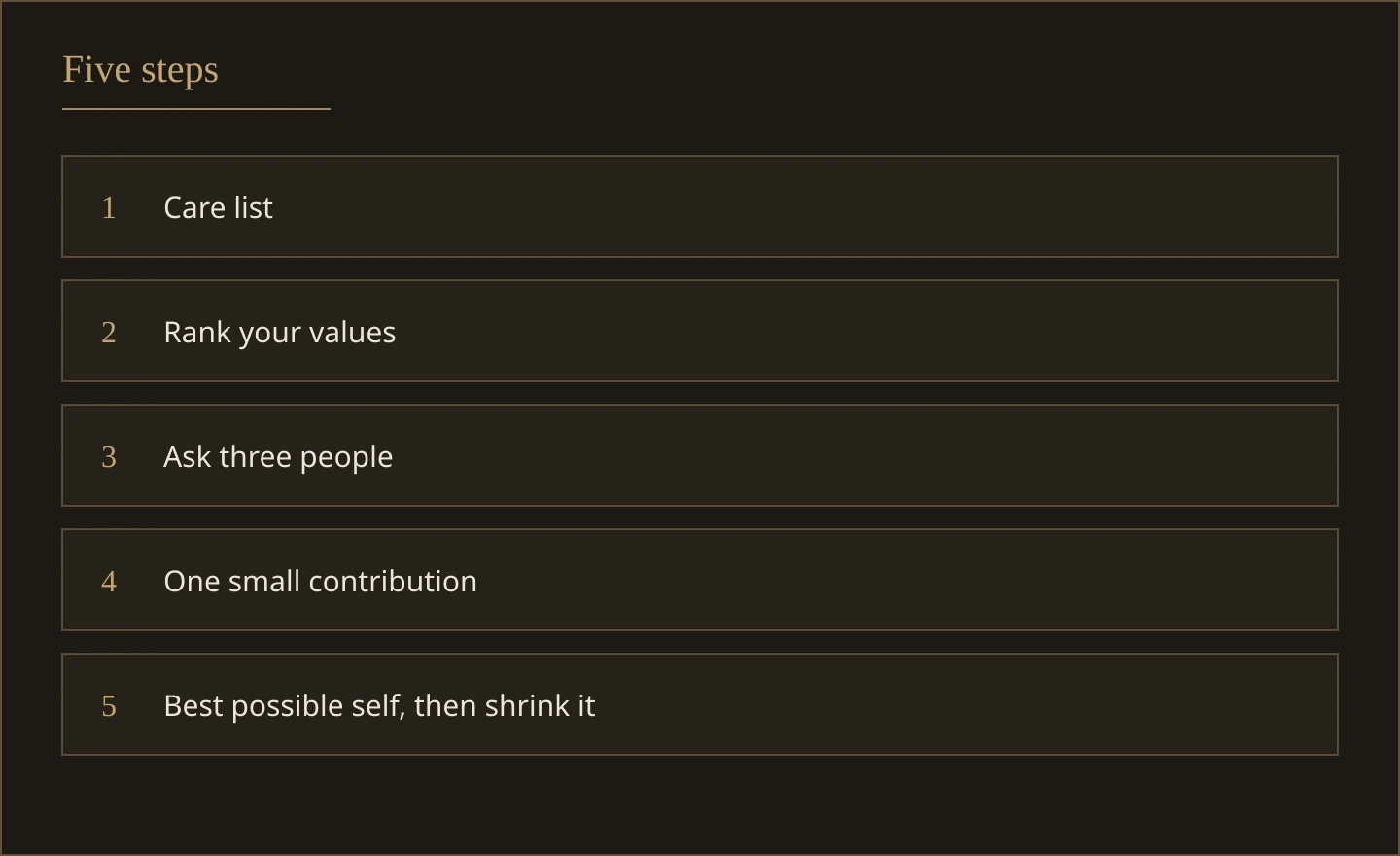
1. Write the care list. List what you already return to when nobody is grading it: a person, a problem in your street or your field, a standard of work, a subject you read when you are tired. Keep it concrete. "I care about justice" is a poster. "I keep rewriting the explanation our new hires never get" is a care. If the list is empty, you are depleted, or you have been living inside other people's commitments. Rest comes before a new vow.
2. Rank your values for this year. Rank them for the next eighteen months, not for a tombstone. Force an order. Circle three you will protect with hours. A value you will not spend time on is a compliment you pay yourself. Note where the current week feeds each one and where it starves it.
3. Ask three people what you are good at. Pick people who have seen the work, not people who love you in general. Ask what they rely on you for. Keep the answers that show up more than once. Discard the flattery and the job title. The pattern under the role, the thing that stays when the seat changes, is who you are when a pattern repeats. It is evidence. It is not a verdict, and it is not a purpose by itself. A strength becomes a purpose only when someone besides you benefits from it.
4. Try one small contribution for a season. Take one item from the care list and one repeated strength, and put them in the same hour. Teach the thing. Fix the thing. Show up for the person. Make it small enough to do without quitting, moving, or announcing a new self. Put it on a day. A purpose you cannot point to on a calendar is still a wish.
5. Write a best possible self, then shrink it. Greater Good in Action uses a short writing practice: describe a future in which things have gone well, in specific scenes rather than slogans. Use it as a picture of a week, not as a destiny. Then circle the one scene you can start in the next month. Keep that. Release the rest until the season has evidence.
At the end of the season, keep the part that still holds when it is inconvenient. Drop the part that only held while it was new. That edit is the practice working.
Purpose at different ages
The practice is the same. The material is not.
In school, the pressure is to treat a major as a self. The commitment is smaller than that: a subject you will still open on a boring week, and a person who is better off because you learned it. Guides for students and majors keep the major the size it actually is.
Around thirty, several lives are still easy to imagine, and the lack of a single aim gets called a crisis. No direction in life at 30 is the page for that. A season of one commitment is a better answer than a personality for the decade.
At forty, the evidence is already in the week. You do not need a reset to have an aim. You need one variable changed on purpose. What to do with my life at 40, without a reset is that constraint, written out.
After a long role ends, the schedule is the first loss, and people mistake the empty morning for an empty life. Finding purpose after retirement, in real weeks starts with the hours the job used to fill. Fill one of them with a commitment that reaches past you before you go looking for a grand second career.
What purpose is not
Purpose is not a job title. A title can carry part of an aim, and an aim that lives only in a title breaks the week the title changes. Keep at least one commitment that does not depend on payroll.
Purpose is not a feeling you have every day. The days you keep the commitment without the feeling are the evidence. The days you have the feeling and cancel the hour are a mood.
Purpose is not a verdict on past years. The last job, the last city, or the last relationship does not need to have been a mistake for the next season to be different. You can thank a chapter and decline to repeat it.
Purpose is also not one permanent sentence. Most people carry several commitments, and the lead one changes. Looking for the single answer is a common reason the search never ends.
Check where yours is thin
If you want to see whether the thin place is what you care about, what you can give, or the practice of keeping a commitment, use the what is my purpose in life quiz. It is ten questions, scored on the page, with no account. A low area is a place to start the five steps. It is not a label, and it is not a verdict on the years behind you.
Where a reading fits
A Meridian Reading is a private 22-section document about the pattern under your commitments and the season you are in, delivered within 48 hours, for $197 once, with a 14-day refund. It cannot practice the purpose for you. The sample reading shows the document. The next hour on the calendar is still yours.
See it on the page
Explore the full sample reading in your browser, or begin your own Entry reading when you are ready.
FAQ
Common questions
Does everyone have one purpose in life?
Is purpose the same as passion?
How long does it take to find your purpose?
Can my job be my purpose?
What if I feel no purpose at all?
Is Meridian Reading an astrology reading?
Continue reading
Related guides
How to find meaning in life again, this season
How to find meaning in life again: name what you still keep, what it costs, and the next commitment small enough to practice in this season.
What is my purpose in life quiz: 10 honest questions
A free what is my purpose in life quiz: ten questions about what you care about, what you are good at, and who benefits, with plain next steps.
How to find out who you really are
How to find out who you really are: the pattern that stays when the role changes, seen in scenes rather than labels, and kept only if you would choose it.
Burnout career change, and meaning in the work
Burnout career change starts by naming what is thin: craft, usefulness, people, or a standard. Change that slice before you quit the whole job.