Learn
What is my purpose in life quiz: 10 honest questions
October 20, 2026
A free what is my purpose in life quiz: ten questions about what you care about, what you are good at, and who benefits, with plain next steps.
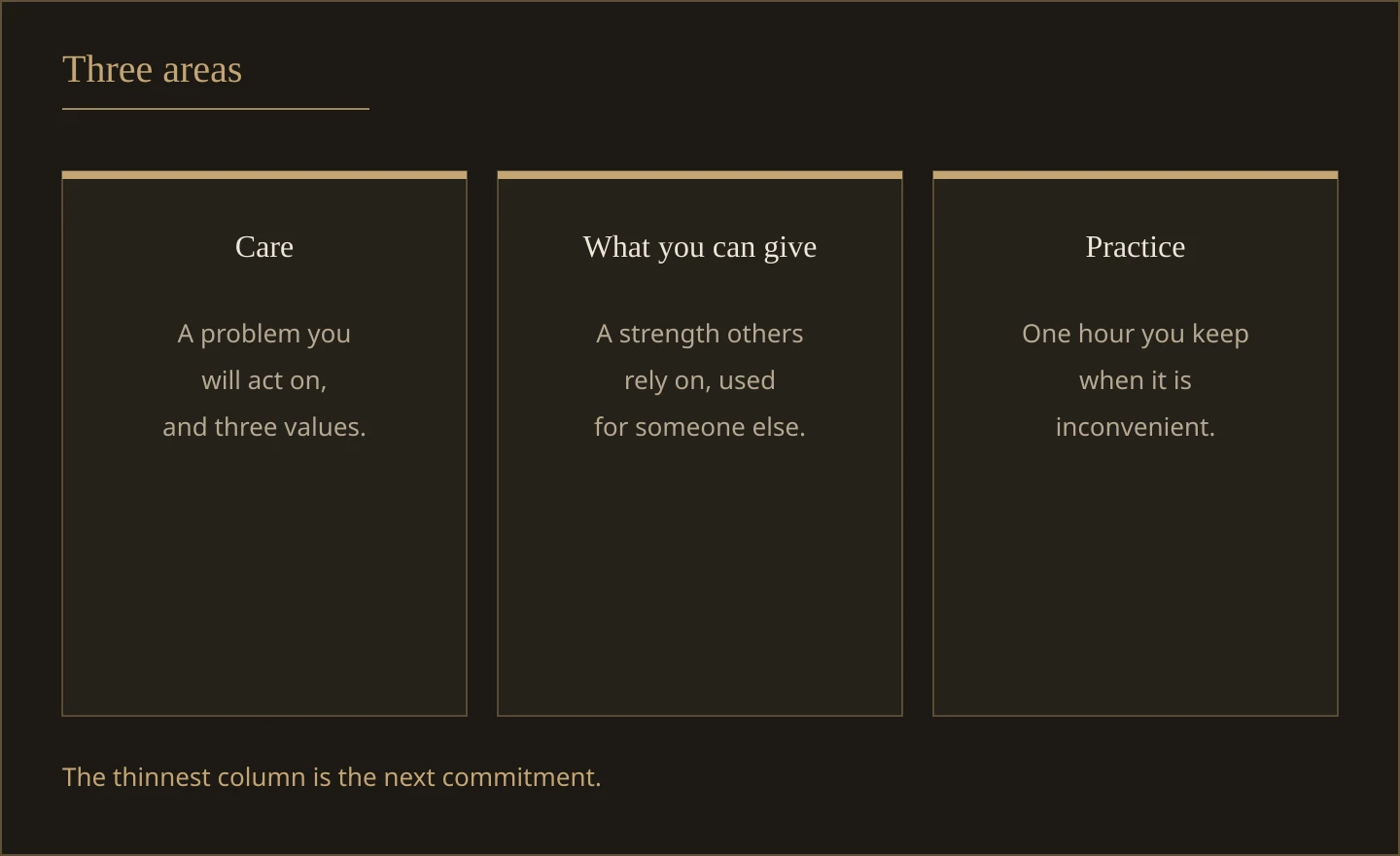
A what is my purpose in life quiz cannot hand you a purpose. It can show where yours is thin: what you care about, what you can give, or the practice of keeping a commitment when it is inconvenient. Answer ten questions. The lowest area is the next small commitment to try this season.
There is no signup and nothing is stored. Print the page or write beside it. Yes requires evidence. A wish is a no with a note.
The longer practice behind the score is how to find your purpose in life, one season at a time. The shelf for meaning, identity, and timing is how to find meaning in life again, this season. The whole library is start here with every guide. If the question is the work, the life around it, and a next step rather than an aim, use the what should I do with my life test.
What this quiz can and cannot do
This quiz can point at a thin area. It cannot finish the sentence for you, and it cannot tell you that a past year was wasted. Purpose, as Greater Good describes it, is a long-term aim that matters to you and reaches beyond you. A quiz is a flashlight. The aim shows up later, in hours you keep.
Three areas, ten questions. Area 1 is what you care about. Area 2 is what you can give. Area 3 is practice: a commitment that survives an inconvenient week. People who feel they have no purpose often have one strong area and a missing one. The missing one is the work. Collecting a new label for the strong area does not build the missing one.
Answer from the last three months. If a move, a new job, or a change at home reset the calendar, say so in the notes. The score is about the current season, not about your character.
Area 1, what you care about
Care that never becomes an action is a mood. These questions ask whether a problem has your attention in the week, not only in conversation.
1.Can you name one problem in your community or field that bothers you enough to act on?
Yes / NoNote
2.Have you spent free time on that problem in the last three months?
Yes / NoNote
3.Can you rank your top three values without stalling?
Yes / NoNote
Question 1 is a no if the problem is "everything" or "the state of the world" with no nearer instance. Question 3 is a no if the ranking takes a speech. An order you can say out loud is enough. The values you will not spend time on do not count, however noble they sound.
Area 2, what you can give
A care without a strength you will actually use becomes a spectator's purpose. These questions ask what other people already rely on, and whether you have used it for someone else.
4.Can you name a strength other people rely on you for?
Yes / NoNote
5.Have you used that strength for someone else's benefit this month?
Yes / NoNote
6.Do you know one setting where that strength is needed and missing?
Yes / NoNote
If you cannot name the strength, do not invent one. Ask three people who have seen you work, and keep what they repeat. That conversation is part of who you are when a pattern repeats. A strength nobody needs in a setting you can reach is a private talent. It may be worth keeping. It is not yet an aim that reaches beyond you.
Area 3, practice
Practice is the area people skip because it is ordinary. An aim you do not keep when it is inconvenient is a preference. Preferences disappear the week they become expensive.
7.Is there a commitment you keep even when it is inconvenient?
Yes / NoNote
8.Does at least one hour of your week go to something beyond yourself?
Yes / NoNote
9.Could you describe the person you hope to be in ten years in a paragraph?
Yes / NoNote
10.Do you have one small next commitment with a date?
Yes / NoNote
Question 9 is a paragraph about a week, not a slogan about a legacy. Best Possible Self is the longer writing exercise if you want a scene instead of a sentence. Question 10 is a no if the date is "someday" or "after I feel sure."
Reading your score
Count yes answers inside each area. Area 1 and Area 2 have three questions. Area 3 has four.
- 3 or more yes in an area is solid. For Area 3, that means at least 3 of 4. Leave a solid area alone while you work on a thinner one.
- Fewer than that means start there.
Area 1 is low. You cannot yet name a care you will act on, or you cannot rank what you refuse to starve. Do the care list and the values rank in how to find your purpose in life, one season at a time. Do not adopt someone else's cause to fill the blank. Borrowed aims feel like purpose for a week and then feel like homework.
Area 2 is low. The care may be real and the gift is unnamed. Ask three people what they rely on you for. Read who you are when a pattern repeats and keep only the strength that shows up in more than one mouth. Then find one setting where that strength is missing and you can reach it without a new identity.
Area 3 is low. You may know what you care about and what you can give, and still cancel the hour. Put one small weekly commitment on a date and keep it when it is dull. How to find meaning in life again, this season is the page for a commitment you protect after you have named what it costs. One kept hour beats a new sentence.
If two areas tie for lowest, start with practice. An unkept commitment teaches you nothing about the other two. If all three are low, the season may have reset you. That is a starting point. It is not a verdict on the person you have been.
The research version
Greater Good's Purpose in Life Quiz uses the Claremont Purpose Scale. It is a researched instrument, and it is worth taking if you want that longer mirror beside this page. It will still not hand you the next hour. Use it the way this page is used: as a picture of where the aim is thin, then return to a commitment small enough to practice.
This ten-question check is shorter on purpose. It is not a validated scale, and it is not a diagnosis. It is finished when you can say which area is thin and which single commitment you will keep this season.
Where a reading fits
A Meridian Reading is a private 22-section document about pattern and season, delivered within 48 hours, for $197 once, with a 14-day refund. It does not score this quiz, and it does not assign a purpose. The sample reading shows the document. The commitment on the calendar is still the practice.
See it on the page
Explore the full sample reading in your browser, or begin your own Entry reading when you are ready.
FAQ
Common questions
Is there a research-based purpose in life quiz?
Can a quiz find my purpose?
Why did I score low?
Is purpose the same as meaning?
Is Meridian Reading an astrology reading?
Continue reading
Related guides
How to find your purpose in life, one season at a time
How to find your purpose in life without waiting for one big answer: what purpose means, a five-step practice, and how it shifts with age.
How to find meaning in life again, this season
How to find meaning in life again: name what you still keep, what it costs, and the next commitment small enough to practice in this season.
What should I do with my life test: 12 questions, no signup
A free what should I do with my life test: twelve yes or no questions about your work, your life, and your next step, scored on the page.
How to find out who you really are
How to find out who you really are: the pattern that stays when the role changes, seen in scenes rather than labels, and kept only if you would choose it.