Learn
What should I do with my life test: 12 questions, no signup
October 20, 2026
A free what should I do with my life test: twelve yes or no questions about your work, your life, and your next step, scored on the page.
This what should I do with my life test is twelve yes or no questions about the last month you actually lived. It does not return a type, a color, or a job title. You count the yes answers in three groups. The lowest group is what to change first, and it points at a guide rather than at a label.
There is nothing to submit and no account. Print it, or write in the notes. Answer yes only when you can point at evidence. A hope that the answer becomes yes after you leap is a no.
The plain essay on the same question, without the score, is what should I do with my life? A plain answer. The work shelf is career and work. If you are still in school, start from guides for students and majors. The whole library is start here with every guide.
How this test works
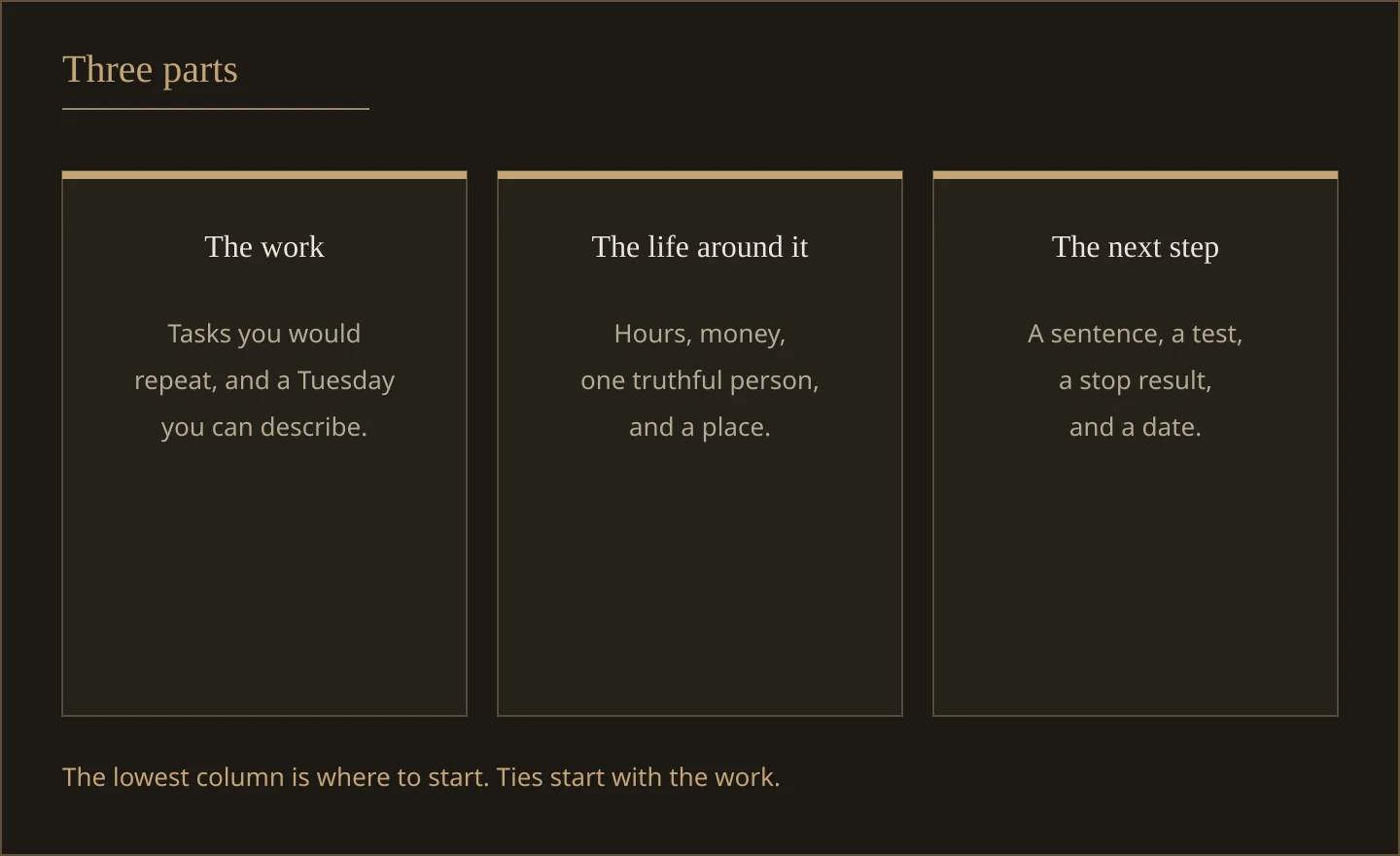
Three things get called "what should I do with my life" and they are not the same problem. The work: tasks you would repeat and can describe. The life around it: time, money, a truthful person, a place. The next step: a sentence, a thirty-day trial, a stop result, and a date. People buy another test when one of those three is thin. The souvenir does not thicken it.
Answer from the last month, not from the life you wish you had documented. If you have to argue yourself into a yes, write no and put the argument in the note. The note is often the useful part.
Part 1, the work
These four questions ask whether the work is specific enough to steer by. A vague pull toward "something more meaningful" is not a yes.
1.Can you name two tasks from the last month you would do again without being asked?
Yes / NoNote
2.Has someone asked for your help with the same kind of problem more than once this year?
Yes / NoNote
3.Do you lose track of time in at least one part of your current work or study?
Yes / NoNote
4.Can you describe an ordinary Tuesday in the work you are drawn to?
Yes / NoNote
A yes on the fourth question is a Tuesday, not a title. If you can describe the status and not the hours, that line is a no. The pattern under the tasks, the part that stays when the role changes, is who you are when a pattern repeats. Use it as evidence about the work. Do not use it as a substitute for the Tuesday.
Part 2, the life around it
A direction that ignores the week around the work becomes a plan you cannot run. These questions check the floor under the experiment.
5.Does your week leave a few hours that belong to you?
Yes / NoNote
6.Are money and housing steady enough to test something for one season?
Yes / NoNote
7.Is there one person who will tell you the plain truth about your plans?
Yes / NoNote
8.Is the place you live giving you more than it costs?
Yes / NoNote
"Steady enough" means you can run a season test without missing rent or hiding the plan from someone who shares the bills. It does not mean the budget is comfortable. A place that costs more than it gives is allowed to be a no even if you like the skyline. Write the cost in the note.
Part 3, the next step
The next step is where a clear wish goes to die. These questions ask whether the wish has a body.
9.Can you say what you want to change in one sentence?
Yes / NoNote
10.Is there a test you could run in the next 30 days without quitting anything?
Yes / NoNote
11.Do you know which result would tell you to stop?
Yes / NoNote
12.Is that first step on a calendar with a date?
Yes / NoNote
Question 10 is a no if the only test you can imagine starts with a resignation. Question 11 is a no if the stop result is a feeling you cannot point at. Question 12 is a no if the date is "when I feel ready."
Reading your score
Count yes answers inside each part. Do not add them into one grand total. A single number hides which problem you have.
- 4 yes in a part: solid. That part can carry a season. Do not reorganize it to avoid the thinner part.
- 2 to 3 yes: mixed. You have a piece of evidence and a hole. Name the hole in one line before you read further.
- 0 to 1 yes: start here. This is the part to change first.
Then follow the lowest part.
The work is lowest. You do not yet have tasks you trust. Read how to find what you want to do in life, then how to pick a career once two options have names. Do not pick a credential to cover the blank.
The life around it is lowest. The direction may be fine and the week cannot hold a test. Read what chapter of life you are in if the calendar changed and the story did not. Read no direction in life at 30 if several lives are still easy to imagine and the structure under them is thin. Stability first makes every other test cheaper.
The next step is lowest. You know enough to act and you have not put a bet on a date. Use how to make a big life decision at a crossroads and leave with one dated action.
A tie. Start with the work. A sharp next step in the service of a vague task becomes a busy week with nothing to learn. If all three parts are 0 or 1, start with the life around it, as the notes above say, and talk to a doctor or counselor if the low scores come with a low mood that will not lift.
Why most life tests stop at a label
The Yale Office of Career Strategy is explicit that an assessment cannot define you or tell you what to do. It suggests where to look next. A test that has to fill every box will fill boxes your month does not support. Two people with the same score can be in opposite seasons. One is choosing a first real job. The other is deciding whether to keep a life that already works.
If you want a wider list of occupations, use a public interest tool and then throw out whatever you cannot describe. The O*NET Interest Profiler and the CareerOneStop self-assessments are built for that widening. CareerOneStop notes that one result can point at hundreds of occupations, including ones that do not interest you. A long list is not a decision. Bring the list back to the twelve questions and delete anything that fails the life around it or has no thirty-day test.
People take another quiz when the first one did not change the week. The second souvenir does not fix the first. This page is finished when you know which part is thin and which guide you will use, not when you have a new name for yourself.
What to do this week
Write one dated action that matches the lowest part. If the work is thin, schedule two conversations with people who do a task you can already describe, and write the Tuesday you heard. If the life around it is thin, pick one floor to steady: an hour that belongs to you, a bill you can name, or one person you will tell the plain version. If the next step is thin, put a thirty-day test on a calendar and write the result that means stop.
The action should be small enough to do without quitting. If it requires an announcement, it is too big for this week.
Where a reading fits
A Meridian Reading is a private 22-section document about pattern and season, delivered within 48 hours, for $197 once, with a 14-day refund. It is not this test, and it does not return a type. The sample reading shows the document. The twelve answers are still yours to count.
See it on the page
Explore the full sample reading in your browser, or begin your own Entry reading when you are ready.
FAQ
Common questions
Is this a scientific test?
How is this different from a career test?
Can a test tell me what to do with my life?
What if I score low in all three parts?
How often should I retake it?
Is Meridian Reading an astrology reading?
Continue reading
Related guides
What should I do with my life? A plain answer
How to find what you want to do in life, beyond a purpose in life quiz. Use the week you have, then test one commitment you can actually keep.
How to find what you want to do in life
How to find what you want to do in life: separate desire, cost, and a trial you can run now, then cross-check the guides for purpose, study, and work.
How to make a big life decision at a crossroads
How to make a big life decision: name one bet, audit your hours, and run a small test with a counted result instead of resigning to find out.
What is my purpose in life quiz: 10 honest questions
A free what is my purpose in life quiz: ten questions about what you care about, what you are good at, and who benefits, with plain next steps.