Learn
Compare two majors before you declare
November 16, 2026
Last updated: November 16, 2026
Compare two majors on one printable page: the ordinary Tuesday, the required work, the years and the money, and one test before you declare.
Download the compare two majors worksheet (PNG)
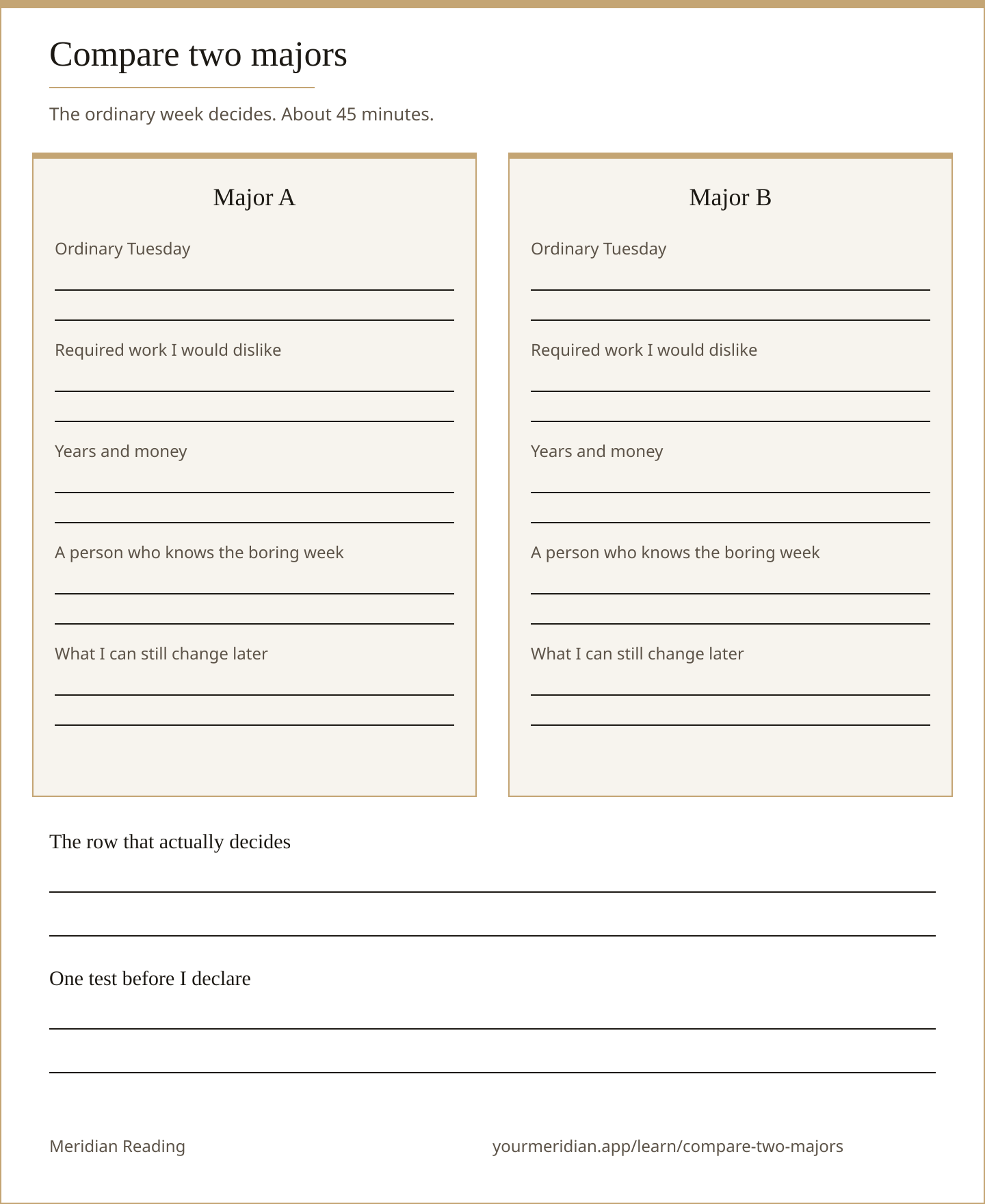
Compare two majors when the form is due and both options are still alive. This is not a verdict on who you are. A major buys skills, time with a subject, sometimes a license, and always a bill. The worksheet asks which Tuesday you can repeat, which requirements you will actually do, and which cost you can carry.
Set aside about 45 minutes. Two majors only. Park the third. If you are still deciding whether to be in school at all, start with what you should study while you are still undecided. The student shelf is guides for students and majors.
An example, filled in
Sam is in year two and torn between nursing and architecture. Dinner has become a debate. The parents can picture a hospital paycheck. Sam can picture a studio.
Nursing, ordinary Tuesday. Charting, a shift, a person in the room who is having a bad day. The required science is work Sam can stand. The license takes years Sam is willing to spend. A nurse on the ward described a February of nights, not a recruitment video. The city already has the jobs.
Architecture, ordinary Tuesday. A studio deadline, a model, a critique that runs long. The degree is longer, and the first jobs cluster in cities Sam has not agreed to move to. A recent graduate described weeks of revisions, not the photograph of the finished building. The parents are not wrong about the slower start.
What Sam does. Sam does not declare at the table. One shift is shadowed. One studio night is sat through. The worksheet is where the two Tuesdays get written before anyone announces a winner. If the shift is tolerable and the studio night is a performance, nursing leads, and architecture stays parked until a city and a bill are real. If the studio night is the hour Sam would protect and the shift is dread, the money row has to be solved on purpose, not ignored.
Your two majors will be different. The rows are the same.
Name the two majors
Write the two that are actually live. A third major you mention so you do not have to choose is a parked option. Give it a condition that would reopen it, or leave it off the page.
Major A, in the words the catalog uses.
Major B, in the words the catalog uses.
A parked major, and the condition that reopens it. Leave blank if you do not have one.
The ordinary Tuesday
Every field has a brochure and a Tuesday. The brochure is the trip, the lab coat, the finished building, the launch. Tuesday is the chart, the problem set, the revision, the shift that repeats.
Ask one person later in each field: "What do you do on a boring week in February?" If they cannot answer, you are talking to the costume. If they answer and you feel relief, that is data. If they answer and you feel dread, that is also data.
Major A. A boring week, in scenes.
Major B. A boring week, in scenes.
Interest in the costume is not a reason to sign up for the Tuesday.
The required work, the years, and the money
Read the requirements, not only the electives. Write the courses you would dislike and still have to finish. Write the years, the debt, a graduate degree the major quietly assumes, and a city you would have to move to.
A constraint is a wall. A preference can be ranked. "My parents prefer the other one" is information about cost and about audience. It is not, by itself, the decision. Hear the bill they are naming. Do not hand them the form.
Major A. Required work I would dislike, years, and money.
Major B. Required work I would dislike, years, and money.
The constraint a parent or a bill is actually naming.
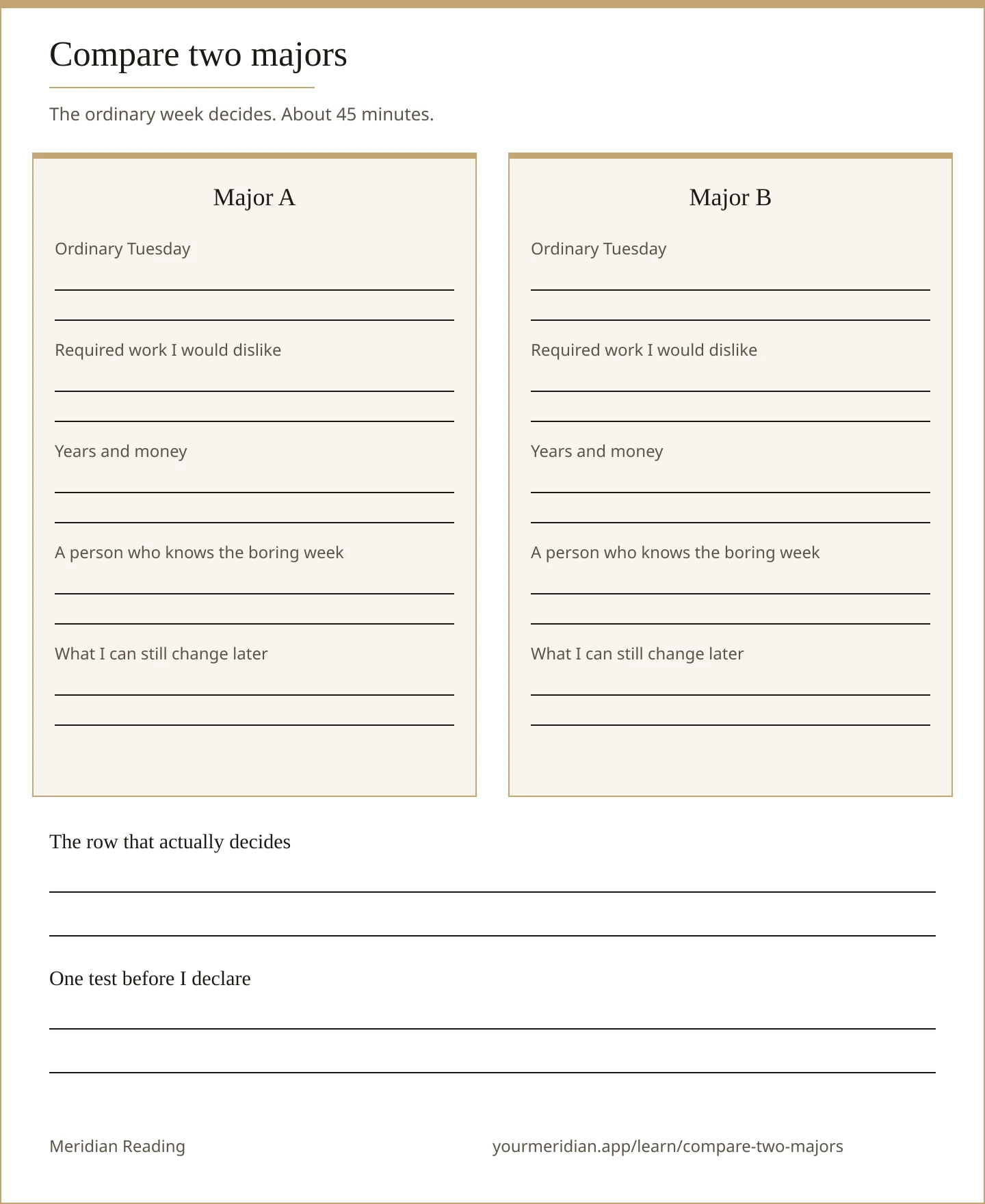
One test before you declare
Research is not contact. A test is one class, one shift, one studio night, one afternoon of the real task, or one conversation you cannot get from a website. Write it before you declare.
If the only way to touch the work is to commit for four years, you are allowed to go slower. A community-college course, a shadow day, or a summer job is a test. A declaration made to end an argument is not.
The fork between two real paths, once they are larger than a major, is how to decide between two paths without doing both at once. If the same freeze shows up in every choice, the pattern is who you are when a pattern repeats. If the major is standing in for what any of it is for, read how to find meaning in life again, this season.
The row that actually decides, and why.
The test I will run before I declare, with a date.
I treat this as the wrong bet if this is still true after a real semester.
A sentence you can say without a speech: "I am studying this for the next two years because the Tuesday is tolerable, the requirements are ones I will do, and the cost is one I can carry."
That sentence is allowed to change. Changing a major early is cheaper than performing a wrong one out of pride.
Free to copy, print, and share this worksheet if you credit Meridian Reading and link to this page.
A Meridian Reading is a private written document about pattern and season. It will not choose your major. The sample reading shows the shape of that document. An advisor, a catalog, and the Tuesday still come first.
See it on the page
Start with the full sample reading. When you want Entry details, open pricing. Begin when you are ready.
FAQ
Common questions
How do I choose between two majors?
What if my parents want the other major?
Should I pick the major that pays more?
What if I am torn and both majors are fine?
Continue reading
Related guides
What should I study if you are still undecided
What should I study when you are undecided: sample the ordinary Tuesday of a field, respect money and time, and treat the major as a bet you can revise.
Guides for students: what to study and what to do
Student guides for what to study, how to choose a major, and how to find what you want to do. A major is a bet you can revise, not a self.
How to find what you want to do in life
How to find what you want to do in life: separate desire, cost, and a trial you can run now, then cross-check the guides for purpose, study, and work.
How to decide between two jobs or career paths
How to decide between two jobs by separating the seat, the field, and the life around them, then testing one path while the rest of life stays put.