Learn
Co-Star and Meridian are not solving the same problem
August 11, 2026
Last updated: October 15, 2026
Compare Co-Star and Meridian: a daily astrological companion versus a single cross-tradition document, what each is for, and who should use both.
People search "Co-Star vs Meridian" expecting a winner. The honest answer is that they belong in different categories.
What Co-Star is built for
Co-Star is a daily astrological companion. It uses birth data to generate natal chart logic, then pushes transit-based prompts and social comparison with friends. The product is designed for frequent, light engagement: open the app, read a line, react, move on.
That is a legitimate use case. Many people want astrology as a recurring ritual, not a one-time document.
What Meridian is built for
Meridian is built for a single structured intake and a single delivered reading. No daily habit, no friend graph, no notification stream. Birth data, name, family details, and geography go through multiple independent interpretive lenses once. Only findings that clear a conviction threshold appear in your private document.
Meridian is not astrology. It is a structured mirror for your life path: cross-referenced, held to a high-conviction threshold, and written in plain language. No jargon. No mystical framing.
Meridian does not do daily horoscopes. That is a scope decision, not a missing feature on our roadmap.
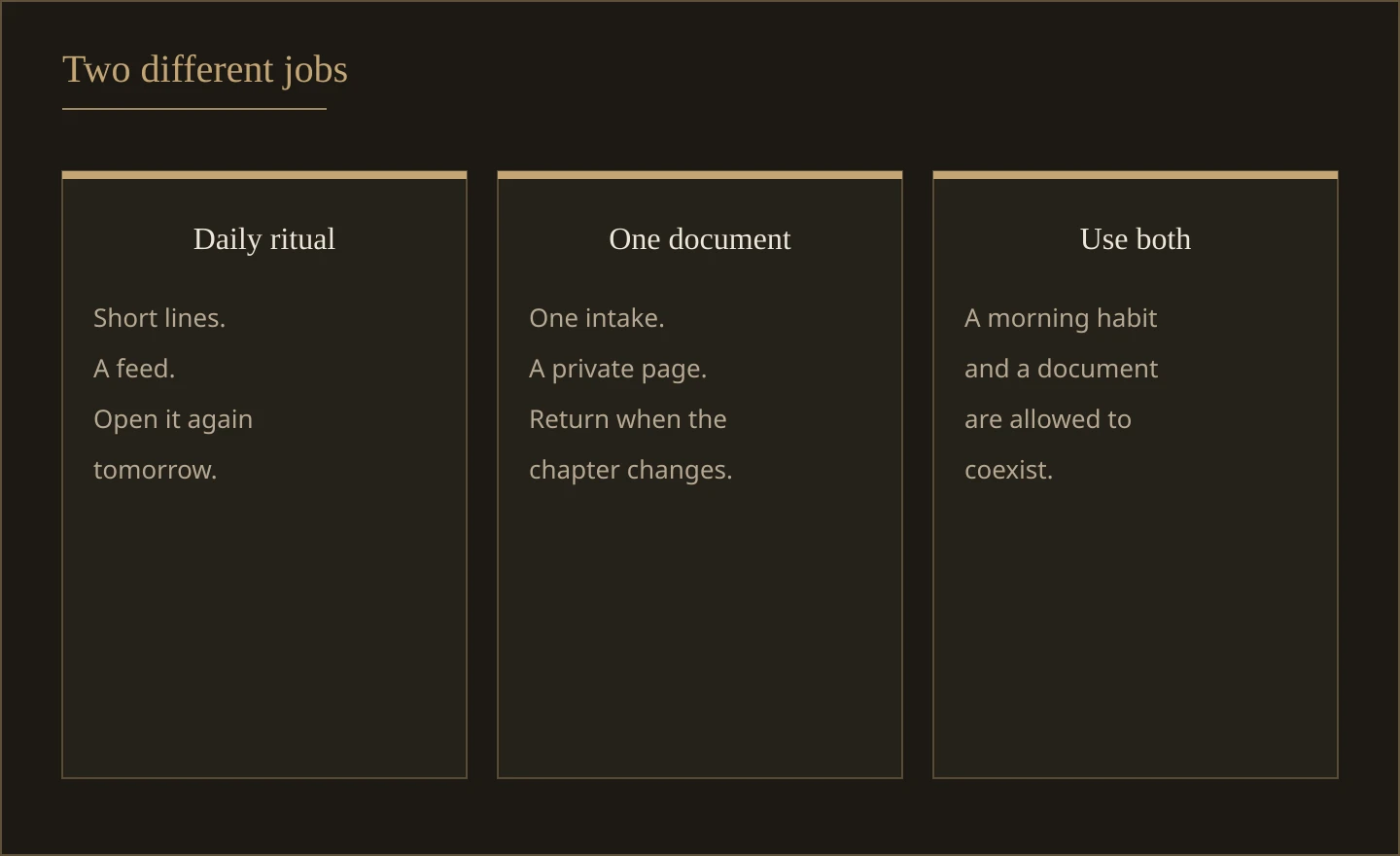
Side by side
Co-Star: Daily cadence. Short prompts and a social feed. Primarily Western astrology. Friend comparisons. Free with premium options.
Meridian: Once (Entry), optional ongoing tiers. Twenty-two-section web document. Cross-tradition convergence. Closest-circle sections, not a feed. Entry $197 one-time.
Feature sets and pricing change. Verify Co-Star's current offering at their site if you are deciding today.
When both make sense
The complementary case is real: someone two years into Co-Star who wants one deeper synthesis instead of another week of transit notifications. Use Co-Star for the daily rhythm. Use Meridian when the chapter you are in calls for a reference document you can reread and test against your life. If the daily prompts were standing in for a self, read who you are when a pattern repeats.
Switching to Meridian is not an upgrade within astrology. It is a category change.
Where to start
Read Why convergence beats a single interpretive lens for the methodology, then open the sample reading to see the full structure. If you wanted another daily astrology app instead, Meridian is the wrong fit. A wider table, including the rest of that daily category, is Meridian Reading versus Co-Star and astrology apps. If the other comparison is a person you meet on a schedule, read Meridian Reading versus a life coach.
See it on the page
Explore the full sample reading in your browser, or begin your own Entry reading when you are ready.
FAQ
Common questions
Which one is better?
Do they use the same birth data?
Does Meridian send daily prompts?
Should I delete Co-Star if I order a reading?
Continue reading
Related guides
What season of life am I in
What season of life am I in, and how do you start a new chapter in life without quitting, moving, and ending everything in the same week. Name it.
How to find out who you really are
How to find out who you really are: the pattern that stays when the role changes, seen in scenes rather than labels, and kept only if you would choose it.
Meridian Reading versus a life coach, compared
Meridian Reading versus a life coach: a scheduled conversation compared with one written document, what each is for, and when keeping both is fair.
Meridian Reading versus career coaching and career tests
Meridian Reading versus a career coach and a career test: a person, a score, and a document, who each fits, and when the reading is the wrong tool.