Learn
How to read a Meridian reading
April 29, 2026
Last updated: October 11, 2026
Conviction labels, welcoming feedback, and free will: how to use your Meridian reading as a mirror you return to, not a script you follow.
Section II of every Meridian reading is titled "How to read this document."
This guide mirrors that section in plain language so you know what to expect before you open your private page, or while you work through the sample reading.
A mirror, not a map
What follows is not a personality test summary or a horoscope. It is a structured analysis of your design, the particular configuration of character, timing, and direction that makes you who you are at this precise moment in your life.
Meridian readings synthesize your data across multiple dimensions: your core character architecture, the chronological pattern of your life, and the specific window of time you are currently moving through. Together, they produce a document intended to be read slowly, returned to often, and used as a reference point in the months ahead.
We ask only that you read it with the same openness you would bring to a trusted mentor's honest feedback, with curiosity over judgment, and with the understanding that clarity, once it arrives, tends to reorder everything quietly around it.
Start with conviction labels
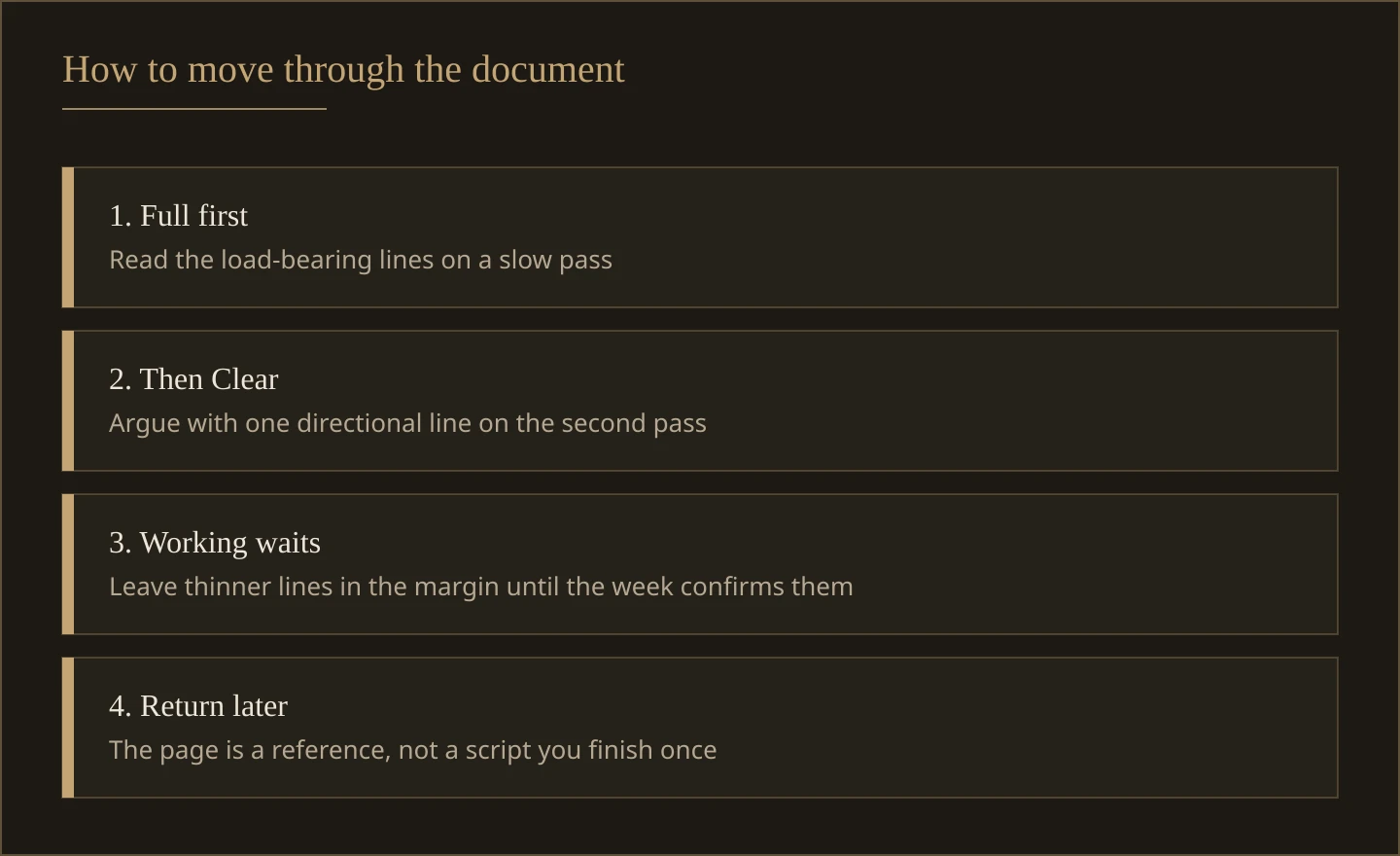
Each section marks how strongly the methodology converged. Full Conviction: treat as load-bearing. It describes how you actually operate. Clear Conviction: strong direction with room for context to shift the shape. Working Conviction: test against your week; if it fits twice, it fits.
Read Full sections first on a slow pass. Argue with one Clear line on a second pass. Leave Working in the margin until life confirms or denies it.
We welcome your reflection
If a line in here lands hard, or misses entirely, the feedback link at the end is the fastest way to sharpen future readings. Specific notes are more useful than general ones. Tell us which sentence, on which page, and what felt off or exact. The reading gets more accurate the more it is challenged.
Free will
Nothing here is fixed. Patterns describe pressure and probability, not script. You can override any tendency on this page by noticing it in real time and choosing the harder, slower move. Read the reading as a map of defaults. The defaults are strong. They are not destiny. The choice in the next hour, day, year, decade is still yours.
A practical first pass
Read once without trying to fix anything. Put it down for a week. Return with a pen: mark the three lines that landed hardest and the one line you want to argue with. The arguments are as useful as the agreements.
Use the chronological map for past pattern recognition, the forward arc for planning horizons, leverage for ranked accelerators and blockers, and tells for early signals that you are on or off track. Share the friends-and-family sections with people who matter. They include shareable versions for a reason.
Use the chronological map when you are asking what chapter of life you are in. Use the character sections when the question is who you are when a pattern repeats. If you opened the document to pick a direction, pair it with which path to choose when the next step splits.
If you have not yet seen the structure, the public sample reading uses the same web reader and conviction labels as a delivered Entry reading. The section-by-section account of that structure is what a full life path reading covers.
See it on the page
Explore the full sample reading in your browser, or begin your own Entry reading when you are ready.
FAQ
Common questions
How is the reading delivered?
What happens after I order?
Is the report private?
Continue reading
Related guides
What season of life am I in
What season of life am I in, and how do you start a new chapter in life without quitting, moving, and ending everything in the same week. Name it.
How to find out who you really are
How to find out who you really are: the pattern that stays when the role changes, seen in scenes rather than labels, and kept only if you would choose it.
How to decide between two jobs or career paths
How to decide between two jobs by separating the seat, the field, and the life around them, then testing one path while the rest of life stays put.
Career crossroads: how to choose your next move at work
Career crossroads, explained: the four moves you can make at work, how to test one for a season, and what to keep steady while you decide.