Learn
MBTI alternatives when you want direction
October 18, 2026
MBTI alternatives for people who want more than a type: Big Five, Enneagram, DISC, CliftonStrengths, and a written reading for direction and life path.
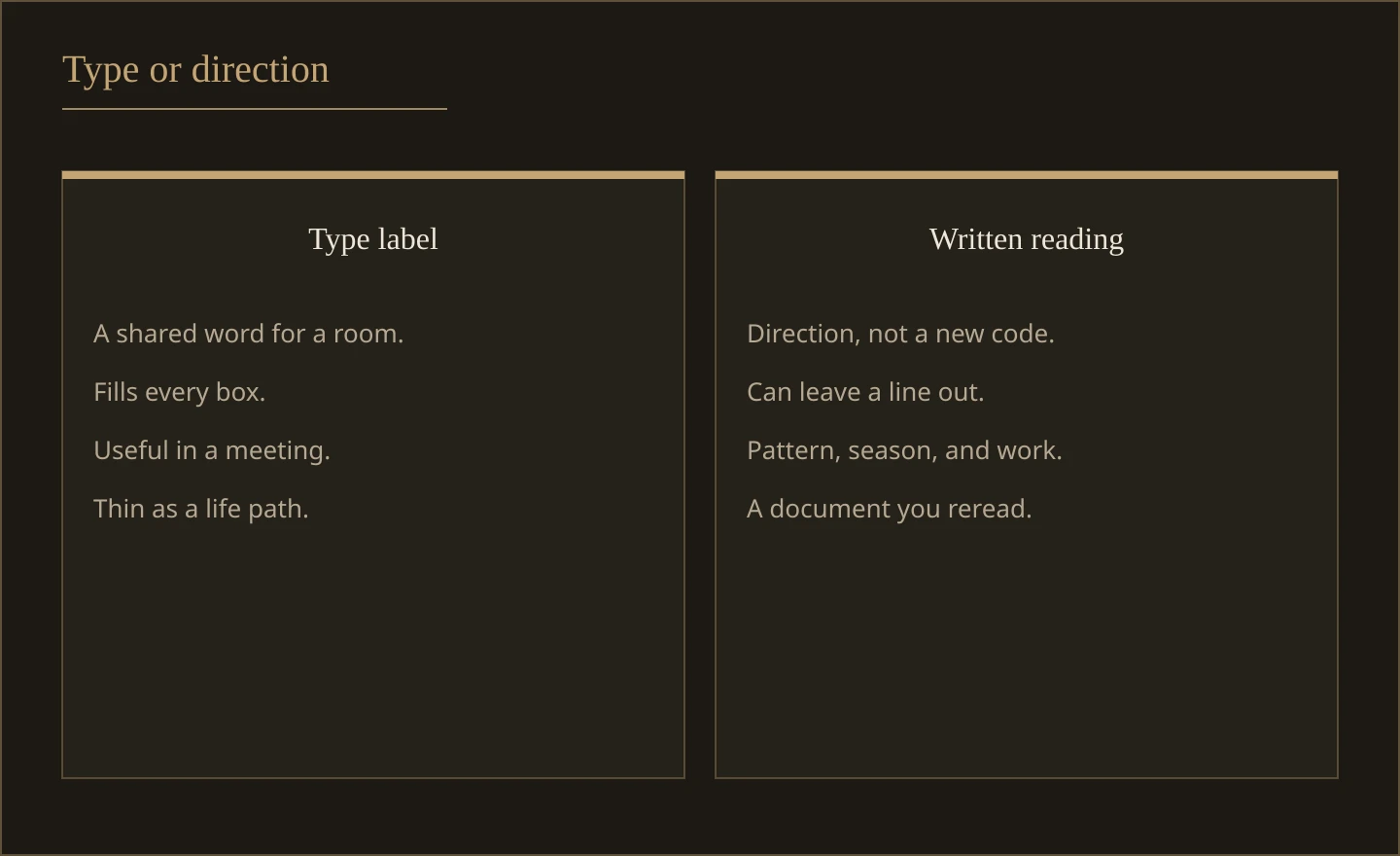
MBTI alternatives are worth sorting by the question you actually have. Four letters are fast. They give a room one vocabulary before lunch. They also have to assign you a box on every dichotomy, including the ones your life does not support. A retest that moves the letters is ordinary. That limit is fine in a workshop. It is a poor instrument for a resignation.
If you want another type, several honest options exist. If you want direction, a type is the wrong shape of answer. The direct comparison of four letters and a written reading is Meridian Reading versus a four-letter type.
Big Five, when you want traits without a story
The Big Five describes people on five broad traits. The scores can move with age and with the room you are in. That movement is a feature. A permanent code would be a lie about traits.
Use it when you want a measured description and you do not need a plot. It will not tell you what chapter of life you are in, and it will not choose between two paths. A high score on one trait is not a career. It is a tendency you can check against last month.
Enneagram, when you want a motivational mirror
The Enneagram offers a number and a story about what you protect and what you fear. Some people recognize themselves in it quickly. Recognition is not the same as a decision. The story still has to place you in a type, and a type cannot leave a line blank.
Hold it the way you would hold any strong metaphor. If it names a pattern you can see in three scenes from the last two years, keep the observation. If it becomes a reason you cannot change, it has outrun its evidence. The pattern under a role is a different page: who you are when a pattern repeats.
DISC, when the room is a team
DISC tells a team how you tend to behave at work. It is a shared word for a standup, a hiring conversation, or a workshop. It was not built to say what this season of your life is for, and it was not built to be a private document you reread at a crossroads.
That limit is the point, not a flaw. Use DISC in the room it was designed for. The longer comparison is Meridian Reading versus DISC.
CliftonStrengths, when the question is a role
CliftonStrengths ranks talents and gives you language for the work you pick up without being asked. Managers use it because a theme is easier to discuss than a vague sense of fit. A top theme can explain why one task feeds you and another empties you.
It does not know your constraints, and it does not owe you a five-year direction. A strength you can demonstrate is evidence about tasks. It is not an assignment to perform that task as your whole life. If the real question is a fork, read which path to choose when the next step splits.
Meridian Reading, when you want direction rather than a type
Meridian Reading is the MBTI alternative for a different question. It does not replace four letters with a new code. It is a structured written reading of your patterns and your direction: what stays when the role changes, which season you are in, and which kinds of work fit the way your attention actually works.
It is a private 22-section life path reading, reviewed individually and delivered within 48 hours, for $197 once. Reflections are labeled Full, Clear, or Working. There is no type to put in an email signature. Read the sample reading if you want to see the document before you decide whether a label was standing in for a life path question.
Keep the tool that matches the room. A meeting can use a type. A season needs something you can reread when the type stops being enough.
See it on the page
Explore the full sample reading in your browser, or begin your own Entry reading when you are ready.
FAQ
Common questions
Should I drop MBTI for one of these alternatives?
Which MBTI alternative should I try first?
Are these just deeper versions of MBTI?
Where does Meridian Reading fit among MBTI alternatives?
Continue reading
Related guides
Why Meridian will not give you four letters
Compare MBTI's typology to Meridian's convergence approach: what a type gives you, what it cannot, and what an unlabeled reading offers instead.
DISC tells your team how you work. It was never trying to tell you why.
Compare DISC's workplace behavior model with Meridian's life path reading: different questions, different audiences, and why they are not really competitors.
How to find out who you really are
How to find out who you really are: the pattern that stays when the role changes, seen in scenes rather than labels, and kept only if you would choose it.
How to choose between two career paths
How to choose between two career paths by separating quit, move, and the work, then testing one. Am I on the right path in life is the wider question.